
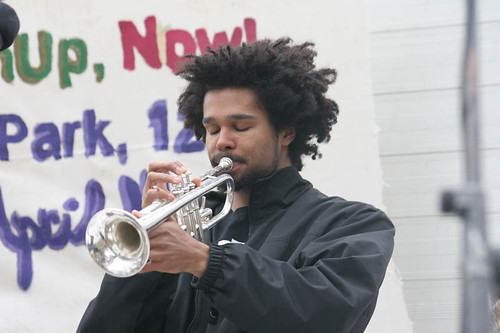
From Afro DZ ak's new album Elevation, "Shine" was produced by Willie Green and features Afro's mighty trumpet. The video was produced by Canyon Cody, recorded in Somerville MA.
Check out the lyrics, preview the music @ Gnawledge, and buy the album at CDBaby, Amazon and iTunes.
Showing posts with label boston. Show all posts
Showing posts with label boston. Show all posts
October 17, 2008

August 21, 2008
Interview: Afro DZ ak
This interview took place over email while Canyon Cody was in Spain working on his Fulbright project and Afro DZ ak was in Boston finishing his album Elevation.
 Canyon Cody: What did your parents listen to when you were growing up?
Afro DZ ak: My mom played violin when she was younger. She listened primarily to classical music - I remember being a little embarrassed when she dropped me off at school and the other kids could hear classical music blasting on the radio. But now I'm so grateful for being surrounded by classical music when I was young, because it gave me a much greater understanding and appreciation for all styles of music as I got older. My mom also had an old record collection-- The Beatles, Aretha Franklin, etc. Through my dad and his side of the family, I was also introduced to music that reflected my own African roots - both traditional and modern Congolese music. I think the first tapes that I bought included Cooleyhighharmony (Boyz II Men), The Chronic (Dr. Dre) and Greatest Misses (Public Enemy).
Canyon Cody: When did you start playing trumpet?
Afro DZ ak: I first started with piano lessons when I was 8. I think a lot of musical ability came from my mom's brother -- he's a piano and flute teacher. My interest in the trumpet actually came from two sources-- first, I went to a summer camp at a local community college where we got to try out all different types of instruments. When I got to the trumpet, tha t was the one that really stood out for me. But the main reason I started playing the trumpet was... a girl. Yeah, in 4th grade I had a crush on this girl who played the trumpet. I was real shy back in the day, and I used to think about how if I learned to play the trumpet, I could sit next to her in band class and win her over. So I started playing trumpet in 5th grade. Since she was one of the best players, I had to practice hard if I wanted to move up in the ranks of all the trumpet players and sit next to her. So that was some good motivation. I took private lessons and practiced every day, and by the time 6th grade rolled around I was first chair and she was second! Though the crush wore off, we ended up becoming good friends, and years later I told her about how she helped inspire me to play the trumpet and we were able to laugh about it.
Canyon Cody: Did you learn trumpet on your own or did you have a mentor?
Afro DZ ak: My trumpet teacher's name was Joe Scannella. He was really into dixieland music, so I played a lot of that. More importantly, as a great trumpet player himself, he taught me all kinds of indispensable tips on playing the trumpet that helped me become the player I am today. But it wasn't until high school that I really started to develop a greater understanding and appreciation for music, especially jazz, thanks to my high school music teacher Eric Haltmeier. He got me into Miles, Trane, etc; and the rest is history. I played in a jazz improv group in high school called Microcosm that was led by Mr. Haltmeier, and that was the catalyst for me becoming a specialist at improvisation, versatility, and bringing creativity and feeling into my music.
 Canyon Cody: What are some of your favorite hip-hop songs that feature trumpets (either live or sampled)?
Afro DZ ak: It's funny, there's actually more hip-hop tracks with saxophone lines that I really dig than there are with trumpets. Some people can't tell the difference betweent sax and trumpet, but I know instantaneously. Some of my favorite sax samples are Pete Rock & CL Smooth's "T.R.O.Y.", Queen Latifah's "UNITY" and Pharcyde's "Passin' Me By".
In terms of trumpet lines, I love how US3 flipped Freddie Hubbard's trumpet solo from Herbie Hancock's "Cantaloupe Island". I also like that real simple trumpet line on Digable Planets' "Cool Like Dat". Lords of the Underground's "Funky Child" has some dope trumpet samples on it too. I'm good friends with a couple of live hip-hop bands that feature trumpets: Audible Mainframe (from Boston, currently in LA) and Lifted (from Boston, now in NYC). Talib Kweli did this track called "Y'all Stay Up" featuring the Youngblood Brass Band, with live trumpets, tubas, trombones... that track is on point.
Canyon Cody: When did you begin to develop as a lyricist? Were you first a (written) poet or did it come from freestlying with other MCs?
Afro DZ ak: Back in the day when I was a kid, I was always more into creative assignments than essays at school, but I never really wrote my own poetry for fun, it was more just for school. I definitely developed as a musician earlier than I developed as a writer. It wasn't until college that I really started to write my own material, and I actually started writing rhymes before I started on the poetry tip. The first rap I recorded was called "Take the A Train". I think I wrote it while I was home from college sometime before my sophomore year at Tufts. It was a collaboration with my brother Nick (aka Mooks). Originally we went by the name "Afro DZ ak" collectively, but then I took over sole possession of it since he didn't have a 'fro. We recorded it at my brother's friend's house in Jersey, and he had Fruity Loops so I made this real bootleg beat and we dropped the track to it. Back at Tufts, I recorded a couple tracks with Stickemz (aka B Reese) and EZV (aka DJ Health) and freestyled at a parties, but never rocked any real shows until my senior year, which is also when I started with spoken word poetry.
Canyon Cody: From your music, it seems like you believe that music can promote positive change. Have there been songs, or musicians, in your life that have influenced you to be a better person, or work for a better community?
Afro DZ ak: As far as musicians/artists that inspire me, the first person that comes to mind is Omekongo Dibinga. I first met him because he was a TA in a course I took at Tufts called African Politics. We immediately connected, in part because we're both Congolese born in the US. Omekongo was one of the first spoken word poets who really made poetry come alive for me - his poems touched on poignant issues about Congo and Africa in general, about racism, sexism, commercialism, about setting a positive example for young people. Probably more than anyone else, he inspired me to write and perform and develop my own poetry. One thing that stands out to me about Omekongo is that he challenges himself to address issues beyond just those that most obviously affect him. For example, he is one of few Black heterosexual male poets I have seen openly speak out against heterosexism / homophobia in his poetry. He also has traveled the world extensively which I think is crucial for someone to really broaden their own frame of mind, and he works tirelessly with young people (in DC these days) to educate and promote positive messages.
I don't know if there have been songs that have influenced me to become a better person, but there are definitely songs that renew my energy and desire to make change, songs that I just put on repeat sometimes because they sustain me in my quest to make a positive difference. Some songs like that would include Blackstar's "Knowledge of Self (Determination)", J-Live's "Brooklyn Public" (a track about being an inner-city school teacher), Arrested Development's "Mr. Wendal", and Pharoahe Monch ft. Talib Kweli & Common "The Truth". I feel like one of the keys to being an MC is listening, just listening to music all the time, listening to other peoples' constructive criticism, listening to your own heart and staying true to that.

Canyon Cody: Tell me about your work in the Big Brothers program.
Afro DZ ak: I got started with Big Brothers when I was a freshman at Tufts through a community service organization called the Leonard Carmichael Society (LCS). I got matched up with Tevin on St. Patrick's Day in 2000, when he was 8 years old. So we've been matched together for over 8 years now, half of his life. He's changed a lot over time, and he has a lot of negative influences around him, so even though his mom does everything she can to provide for him, I know things aren't easy for Tevin. We have our ups and downs, but over the years we've shared so much together: going to Celtics games, Sox games, museums, the beach, recording music, playing sports, going sledding, just hanging out.
I really consider Tevin a part of my family, I think one of the reasons I first decided to be a Big Brother is because I missed my biological brother Nick when I went off to college. While my relationship with Tevin is completely different from my relationship with Nick (who is now 24), Tevin really is like another brother to me. Tevin and Nick have met each other a few times also and get along real well. Most matches through Big Brothers/Big Sisters last only a year or two, but Tevin and I have developed a bond that goes beyond the requirements of the Big Brothers program and represents a real friendship. He knows that I will always have his back.
 Canyon Cody: How did you get connected with The Eclectic Collective and how did you decide to part ways?
Afro DZ ak: I first connected with The Eclectic Collective at concert at Harper's Ferry in Allston, and the promoter (Onslaught, aka Lionel Brown) booked me as the opening act for the show. In addition to The Eclectic Collective, there was another live hip-hop act called Audible Mainframe who performed as well. The whole show was real dope, and it got me excited about live band hip hop/soul in Boston. Especially this one song by EC, "Souls on Ice", which literally made me want to grab my trumpet and jump on stage and start playing while they were performing. At the time, I had recently started playing with a Worcester-based band, Soul Movement, we got booked for another show with the EC. After that show, they asked me if I wanted to join the band, because they were looking to add a horn player to their sound and they were diggin the trumpet that I had played during my solo set and the Soul Movement set.
As far as my leaving the band, that was one of the hardest decisions I've made, but one that in retrospect I'm happy with. In a way, EC was a victim of their own success. Things got to the stage w here everyone was quitting their day jobs to tour with the band full time, and I felt like I had too much to give up to do that. I love my job with ACCESS, working with high school students, and both for my own sake and the sake of the students I work with, I wasn't willing to give that up. Also, musically the band was steering more and more away from hip hop & soul and becoming more and more rock, and while the music was still good, it wasn't really me. I wasn't down with putting all my eggs in one basket, especially when I felt like I had so much to offer in my day job. And since I have left the band, I have been able to do so many things, including playing all over Gnotes' and Elemental Zazen's albums, joining the Gnawledge family, and recording my solo album, which I never would have been able to do otherwise.
Canyon Cody: You must really love you day job -- tell me about your what you do.
Afro DZ ak: I am a Financial Aid Advisor for ACCESS (www.accessboston.org). I work one-on-one throughout the school year with High School Seniors in the Boston Public Schools to help them get financial aid for college. Filling out the FAFSA, applying for scholarships, taking out loans, etc; etc; I also do presentations, parent nights, etc; about financial aid. I work in collaboration with teachers, guidance counselors, and administrators in the schools to meet with students during the school day and make sure they get all the financial aid they deserve so that money doesn't prove to be a barrier preventing them from achieving their college dreams.
The strong majority of BPS students receive free/reduced lunch and many are the first in their families to go to college. The vast majority are students of color. The schools I work at are Brighton High School, Greater Egleston Community High School, and Boston Adult Technical Academy. In the process of assisting students with the financial aid process, I also serve as a mentor to countless students, helping them navigate the often overwhelming process of getting through their crucial senior year in high school while putting all the necessary pieces of the puzzle together to go on to college.
 Canyon Cody: What did your parents listen to when you were growing up?
Afro DZ ak: My mom played violin when she was younger. She listened primarily to classical music - I remember being a little embarrassed when she dropped me off at school and the other kids could hear classical music blasting on the radio. But now I'm so grateful for being surrounded by classical music when I was young, because it gave me a much greater understanding and appreciation for all styles of music as I got older. My mom also had an old record collection-- The Beatles, Aretha Franklin, etc. Through my dad and his side of the family, I was also introduced to music that reflected my own African roots - both traditional and modern Congolese music. I think the first tapes that I bought included Cooleyhighharmony (Boyz II Men), The Chronic (Dr. Dre) and Greatest Misses (Public Enemy).
Canyon Cody: When did you start playing trumpet?
Afro DZ ak: I first started with piano lessons when I was 8. I think a lot of musical ability came from my mom's brother -- he's a piano and flute teacher. My interest in the trumpet actually came from two sources-- first, I went to a summer camp at a local community college where we got to try out all different types of instruments. When I got to the trumpet, tha
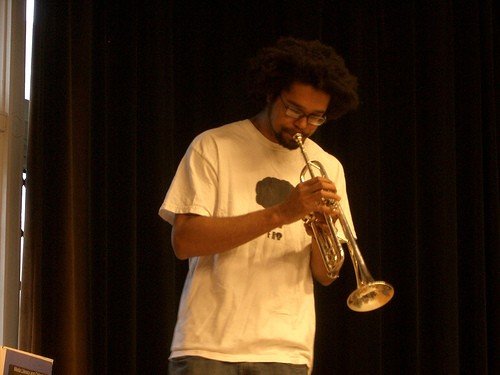 t was the one that really stood out for me. But the main reason I started playing the trumpet was... a girl. Yeah, in 4th grade I had a crush on this girl who played the trumpet. I was real shy back in the day, and I used to think about how if I learned to play the trumpet, I could sit next to her in band class and win her over. So I started playing trumpet in 5th grade. Since she was one of the best players, I had to practice hard if I wanted to move up in the ranks of all the trumpet players and sit next to her. So that was some good motivation. I took private lessons and practiced every day, and by the time 6th grade rolled around I was first chair and she was second! Though the crush wore off, we ended up becoming good friends, and years later I told her about how she helped inspire me to play the trumpet and we were able to laugh about it.
Canyon Cody: Did you learn trumpet on your own or did you have a mentor?
Afro DZ ak: My trumpet teacher's name was Joe Scannella. He was really into dixieland music, so I played a lot of that. More importantly, as a great trumpet player himself, he taught me all kinds of indispensable tips on playing the trumpet that helped me become the player I am today. But it wasn't until high school that I really started to develop a greater understanding and appreciation for music, especially jazz, thanks to my high school music teacher Eric Haltmeier. He got me into Miles, Trane, etc; and the rest is history. I played in a jazz improv group in high school called Microcosm that was led by Mr. Haltmeier, and that was the catalyst for me becoming a specialist at improvisation, versatility, and bringing creativity and feeling into my music.
 Canyon Cody: What are some of your favorite hip-hop songs that feature trumpets (either live or sampled)?
Afro DZ ak: It's funny, there's actually more hip-hop tracks with saxophone lines that I really dig than there are with trumpets. Some people can't tell the difference betweent sax and trumpet, but I know instantaneously. Some of my favorite sax samples are Pete Rock & CL Smooth's "T.R.O.Y.", Queen Latifah's "UNITY" and Pharcyde's "Passin' Me By".
In terms of trumpet lines, I love how US3 flipped Freddie Hubbard's trumpet solo from Herbie Hancock's "Cantaloupe Island". I also like that real simple trumpet line on Digable Planets' "Cool Like Dat". Lords of the Underground's "Funky Child" has some dope trumpet samples on it too. I'm good friends with a couple of live hip-hop bands that feature trumpets: Audible Mainframe (from Boston, currently in LA) and Lifted (from Boston, now in NYC). Talib Kweli did this track called "Y'all Stay Up" featuring the Youngblood Brass Band, with live trumpets, tubas, trombones... that track is on point.
Canyon Cody: When did you begin to develop as a lyricist? Were you first a (written) poet or did it come from freestlying with other MCs?
Afro DZ ak: Back in the day when I was a kid, I was always more into creative assignments than essays at school, but I never really wrote my own poetry for fun, it was more just for school. I definitely developed as a musician earlier than I developed as a writer. It wasn't until college that I really started to write my own material, and I actually started writing
 rhymes before I started on the poetry tip. The first rap I recorded was called "Take the A Train". I think I wrote it while I was home from college sometime before my sophomore year at Tufts. It was a collaboration with my brother Nick (aka Mooks). Originally we went by the name "Afro DZ ak" collectively, but then I took over sole possession of it since he didn't have a 'fro. We recorded it at my brother's friend's house in Jersey, and he had Fruity Loops so I made this real bootleg beat and we dropped the track to it. Back at Tufts, I recorded a couple tracks with Stickemz (aka B Reese) and EZV (aka DJ Health) and freestyled at a parties, but never rocked any real shows until my senior year, which is also when I started with spoken word poetry.
Canyon Cody: From your music, it seems like you believe that music can promote positive change. Have there been songs, or musicians, in your life that have influenced you to be a better person, or work for a better community?
Afro DZ ak: As far as musicians/artists that inspire me, the first person that comes to mind is Omekongo Dibinga. I first met him because he was a TA in a course I took at Tufts called
 African Politics. We immediately connected, in part because we're both Congolese born in the US. Omekongo was one of the first spoken word poets who really made poetry come alive for me - his poems touched on poignant issues about Congo and Africa in general, about racism, sexism, commercialism, about setting a positive example for young people. Probably more than anyone else, he inspired me to write and perform and develop my own poetry. One thing that stands out to me about Omekongo is that he challenges himself to address issues beyond just those that most obviously affect him. For example, he is one of few Black heterosexual male poets I have seen openly speak out against heterosexism / homophobia in his poetry. He also has traveled the world extensively which I think is crucial for someone to really broaden their own frame of mind, and he works tirelessly with young people (in DC these days) to educate and promote positive messages.
I don't know if there have been songs that have influenced me to become a better person, but there are definitely songs that renew my energy and desire to make change, songs that I just put on repeat sometimes because they sustain me in my quest to make a positive difference. Some songs like that would include Blackstar's "Knowledge of Self (Determination)", J-Live's "Brooklyn Public" (a track about being an inner-city school teacher), Arrested Development's "Mr. Wendal", and Pharoahe Monch ft. Talib Kweli & Common "The Truth". I feel like one of the keys to being an MC is listening, just listening to music all the time, listening to other peoples' constructive criticism, listening to your own heart and staying true to that.
Canyon Cody: Tell me about your work in the Big Brothers program.
Afro DZ ak: I got started with Big Brothers when I was a freshman at Tufts through a community service organization called the Leonard Carmichael Society (LCS). I got matched up with Tevin on St. Patrick's Day in 2000, when he was 8 years old. So we've been matched together for over 8 years now, half of his life. He's changed a lot over time, and he has a lot of negative influences around him, so even though his mom does everything she can to provide for him, I know things aren't easy for Tevin. We have our ups and downs, but over the years we've shared so much together: going to Celtics games, Sox games, museums, the beach, recording music, playing sports, going sledding, just hanging out.
I really consider Tevin a part of my family, I think one of the reasons I first decided to be a Big Brother is because I missed my biological brother Nick when I went off to college. While my relationship with Tevin is completely different from my relationship with Nick (who is now 24), Tevin really is like another brother to me. Tevin and Nick have met each other a few times also and get along real well. Most matches through Big Brothers/Big Sisters last only a year or two, but Tevin and I have developed a bond that goes beyond the requirements of the Big Brothers program and represents a real friendship. He knows that I will always have his back.
 Canyon Cody: How did you get connected with The Eclectic Collective and how did you decide to part ways?
Afro DZ ak: I first connected with The Eclectic Collective at concert at Harper's Ferry in Allston, and the promoter (Onslaught, aka Lionel Brown) booked me as the opening act for the show. In addition to The Eclectic Collective, there was another live hip-hop act called Audible Mainframe who performed as well. The whole show was real dope, and it got me excited about live band hip hop/soul in Boston. Especially this one song by EC, "Souls on Ice", which literally made me want to grab my trumpet and jump on stage and start playing while they were performing. At the time, I had recently started playing with a Worcester-based band, Soul Movement, we got booked for another show with the EC. After that show, they asked me if I wanted to join the band, because they were looking to add a horn player to their sound and they were diggin the trumpet that I had played during my solo set and the Soul Movement set.
As far as my leaving the band, that was one of the hardest decisions I've made, but one that in retrospect I'm happy with. In a way, EC was a victim of their own success. Things got to the stage w
 here everyone was quitting their day jobs to tour with the band full time, and I felt like I had too much to give up to do that. I love my job with ACCESS, working with high school students, and both for my own sake and the sake of the students I work with, I wasn't willing to give that up. Also, musically the band was steering more and more away from hip hop & soul and becoming more and more rock, and while the music was still good, it wasn't really me. I wasn't down with putting all my eggs in one basket, especially when I felt like I had so much to offer in my day job. And since I have left the band, I have been able to do so many things, including playing all over Gnotes' and Elemental Zazen's albums, joining the Gnawledge family, and recording my solo album, which I never would have been able to do otherwise.
Canyon Cody: You must really love you day job -- tell me about your what you do.
Afro DZ ak: I am a Financial Aid Advisor for ACCESS (www.accessboston.org). I work one-on-one throughout the school year with High School Seniors in the Boston Public Schools to help them get financial aid for college. Filling out the FAFSA, applying for scholarships, taking out loans, etc; etc; I also do presentations, parent nights, etc; about financial aid. I work in collaboration with teachers, guidance counselors, and administrators in the schools to meet with students during the school day and make sure they get all the financial aid they deserve so that money doesn't prove to be a barrier preventing them from achieving their college dreams.
The strong majority of BPS students receive free/reduced lunch and many are the first in their families to go to college. The vast majority are students of color. The schools I work at are Brighton High School, Greater Egleston Community High School, and Boston Adult Technical Academy. In the process of assisting students with the financial aid process, I also serve as a mentor to countless students, helping them navigate the often overwhelming process of getting through their crucial senior year in high school while putting all the necessary pieces of the puzzle together to go on to college.
November 17, 2005
Hell hath no fury like a rapper scorned
By Canyon Cody
Originally published in The Heights
After Immortal Technique released Revolutionary Warfare, Vol.1 in August 2001, the United States government responded by passing The Patriot Act just two months later. If you thought The Patriot Act and the war in Iraq was about fighting terrorism, then let Immortal Technique drop some gnawledge for you:
"A fake church called the prophet Muhammad a terrorist / Forgetting God is not a religion, but a spiritual bond / And Jesus is the most quoted prophet in the Qu'ran / They bombed innocent people, tryin' to murder Saddam / When you gave him those chemical weapons to go to war with Iran," he raps on "The 4th Branch."
Tech isn't your typical "socially-conscious" rapper with polite rhymes about peace and love. His style is belligerent, his verses are vulgar, and his gnawledge is raw, the sort of stuff you need to chew on a minute. For fans of intelligent, revolutionary, hardcore hip-hop, there hasn't been a better rapper since 2Pac went to Cuba.
Immortal Technique will be performing at the Middle East on Sunday and granted a rare interview with The Heights to talk about his history, his upcoming album, and his controversial political views.
They say hell hath no fury like a woman scorned, but Tech raps with the fury of five centuries of women, men, and children scorned by colonialism and capitalism.
Born in a military hospital in Peru, raised in Harlem, and imprisoned in Pennsylvania before emerging as the most feared battle rapper in New York, Immortal Technique has some serious grievances with the American government.
Kanye recently caused a media frenzy by saying, "Bush doesn't care about black people." Tech's been screaming that for years, with a much more articulate voice and a lot more supporting evidence.
Though he's often compared to rappers like Chuck D, dead prez, and KRS-One, Tech said his real influences are W.E.B. Du Bois, Jose Carlos Mariategui, Malcolm X, Che Guevara, Augusto Sandino, Harriet Tubman, and Marcus Garvey.
Like Ras Kass before him, Immortal Technique doesn't just rap about living in the hood - he understands the larger historic and economic forces that perpetuate poverty and racism. As a result, Tech doesn't peddle petty beefs with other rappers. Eminem raps about having "so much anger aimed in no particular direction," while Immortal Technique points the crosshairs of his scope directly at the heart of the beast: the U.S. government and the corporations that he says control it.
"You might have some house n- fooled, but I understand / Colonialism is sponsored by corporations / That's why Halliburton gets paid to rebuild nations," he raps on "Cause of Death."
But Tech's anger wasn't always focused in the right direction. "In high school I was always doing stupid shit snatchin' nigga's chains, gettin' into fights. I look back and I wonder how I could even live like that, but I brought that attitude with me from the streets to Penn State," he said.
While still in college, he was involved in an altercation sparked by a racist comment that led to a broken jaw for a white student and a year in prison for Immortal Technique.
"When I came home from prison, I was living with my parents. I was on parole and I couldn't get a job. It's a very humbling experience getting out of jail," he said.
Tech started going to battles to earn some money, but ended up also earning a reputation for being a ruthless MC. "I wanted to make sure that people knew that I wasn't just one of these little backpacking fucks who rhymed in a circle," he said in a previous interview. "I never got destroyed or roasted by anyone, period. Anyone who says different is getting their father slapped up and their mother thrown down a flight of fucking stairs just for lying."
"Finally I decided to take all the songs I wrote in prison, with that young angry pissed off voice and release an album. Because even if I sold five a day, that's $50, I could buy groceries with that, you know, I could eat," he said.
The result was Revolutionary Warfare, Vol. 1, which eventually earned him a place in The Source's "Unsigned Hype" column in November 2003. He started getting offers from major labels, but decided to remain independent after reading up on the exploitation of artists in the music business. As a result, he released Vol. 2 independently, which means he owns all of his own masters and pocketed all the profits from the 75,000 copies sold.
Tech's career has been the ideal model for the do-it-yourself underground hip-hop MC. Tech decided against signing to a label because they wanted him to change his style, to downplay his politics, and ignore his black and hispanic heritage.
"That's the difference between the Civil Rights movement and the Black Panther / Hip-hop Generation. In the beginning we wanted to be down with America, not as second class citizens, but really to become full American citizens. We wanted to be down with America so bad that we were willing to fight and die in America's wars. And when we got back, we still weren't allowed to be full American citizens.
"America told us that we were basically here to work and die, kinda like how America treats Mexicans today. We tried that. So now then the hip-hop generation is sayin, 'Fuck waiting for America to accept us. We'll build our own America inside of you.'"
Two years ago, he bragged that, "My grind right now is unsurpassed. I have no booking agent. I have no manager, so it all relies on me. My manager is my voicemail, cell phone, and my e-mail."
He's now vice president of his own label, Viper Records, with plans to release his next album The Middle Passage, in mid-2006. By now I figured he would have hired a publicist who would reply to my interview request, but to my surprise an unknown number from a 212-area code popped up on my cell phone:
"What up nigga? This is Immortal Technique!"
By Canyon Cody
Originally published in The Heights
After Immortal Technique released Revolutionary Warfare, Vol.1 in August 2001, the United States government responded by passing The Patriot Act just two months later. If you thought The Patriot Act and the war in Iraq was about fighting terrorism, then let Immortal Technique drop some gnawledge for you:
"A fake church called the prophet Muhammad a terrorist / Forgetting God is not a religion, but a spiritual bond / And Jesus is the most quoted prophet in the Qu'ran / They bombed innocent people, tryin' to murder Saddam / When you gave him those chemical weapons to go to war with Iran," he raps on "The 4th Branch."
Tech isn't your typical "socially-conscious" rapper with polite rhymes about peace and love. His style is belligerent, his verses are vulgar, and his gnawledge is raw, the sort of stuff you need to chew on a minute. For fans of intelligent, revolutionary, hardcore hip-hop, there hasn't been a better rapper since 2Pac went to Cuba.
Immortal Technique will be performing at the Middle East on Sunday and granted a rare interview with The Heights to talk about his history, his upcoming album, and his controversial political views.
They say hell hath no fury like a woman scorned, but Tech raps with the fury of five centuries of women, men, and children scorned by colonialism and capitalism.
Born in a military hospital in Peru, raised in Harlem, and imprisoned in Pennsylvania before emerging as the most feared battle rapper in New York, Immortal Technique has some serious grievances with the American government.
Kanye recently caused a media frenzy by saying, "Bush doesn't care about black people." Tech's been screaming that for years, with a much more articulate voice and a lot more supporting evidence.
Though he's often compared to rappers like Chuck D, dead prez, and KRS-One, Tech said his real influences are W.E.B. Du Bois, Jose Carlos Mariategui, Malcolm X, Che Guevara, Augusto Sandino, Harriet Tubman, and Marcus Garvey.
Like Ras Kass before him, Immortal Technique doesn't just rap about living in the hood - he understands the larger historic and economic forces that perpetuate poverty and racism. As a result, Tech doesn't peddle petty beefs with other rappers. Eminem raps about having "so much anger aimed in no particular direction," while Immortal Technique points the crosshairs of his scope directly at the heart of the beast: the U.S. government and the corporations that he says control it.
"You might have some house n- fooled, but I understand / Colonialism is sponsored by corporations / That's why Halliburton gets paid to rebuild nations," he raps on "Cause of Death."
But Tech's anger wasn't always focused in the right direction. "In high school I was always doing stupid shit snatchin' nigga's chains, gettin' into fights. I look back and I wonder how I could even live like that, but I brought that attitude with me from the streets to Penn State," he said.
While still in college, he was involved in an altercation sparked by a racist comment that led to a broken jaw for a white student and a year in prison for Immortal Technique.
"When I came home from prison, I was living with my parents. I was on parole and I couldn't get a job. It's a very humbling experience getting out of jail," he said.
Tech started going to battles to earn some money, but ended up also earning a reputation for being a ruthless MC. "I wanted to make sure that people knew that I wasn't just one of these little backpacking fucks who rhymed in a circle," he said in a previous interview. "I never got destroyed or roasted by anyone, period. Anyone who says different is getting their father slapped up and their mother thrown down a flight of fucking stairs just for lying."
"Finally I decided to take all the songs I wrote in prison, with that young angry pissed off voice and release an album. Because even if I sold five a day, that's $50, I could buy groceries with that, you know, I could eat," he said.
The result was Revolutionary Warfare, Vol. 1, which eventually earned him a place in The Source's "Unsigned Hype" column in November 2003. He started getting offers from major labels, but decided to remain independent after reading up on the exploitation of artists in the music business. As a result, he released Vol. 2 independently, which means he owns all of his own masters and pocketed all the profits from the 75,000 copies sold.
Tech's career has been the ideal model for the do-it-yourself underground hip-hop MC. Tech decided against signing to a label because they wanted him to change his style, to downplay his politics, and ignore his black and hispanic heritage.
"That's the difference between the Civil Rights movement and the Black Panther / Hip-hop Generation. In the beginning we wanted to be down with America, not as second class citizens, but really to become full American citizens. We wanted to be down with America so bad that we were willing to fight and die in America's wars. And when we got back, we still weren't allowed to be full American citizens.
"America told us that we were basically here to work and die, kinda like how America treats Mexicans today. We tried that. So now then the hip-hop generation is sayin, 'Fuck waiting for America to accept us. We'll build our own America inside of you.'"
Two years ago, he bragged that, "My grind right now is unsurpassed. I have no booking agent. I have no manager, so it all relies on me. My manager is my voicemail, cell phone, and my e-mail."
He's now vice president of his own label, Viper Records, with plans to release his next album The Middle Passage, in mid-2006. By now I figured he would have hired a publicist who would reply to my interview request, but to my surprise an unknown number from a 212-area code popped up on my cell phone:
"What up nigga? This is Immortal Technique!"
April 7, 2005
Mixtape Friday: Kweli makes friends with Day
By Canyon Cody
Published in The Heights
It gives me the giggles to think about how awkward it's going to be backstage at tomorrow night's spring concert at Boston College.
What will Talib Kweli, Howie Day, and Robert Randolph chat about before the show? Where will the UGBC put them? In the guys' locker room, sitting on the benches like it was halftime with the basketball team waiting for a pep talk from Al Skinner?
I don't know how this happens, but the UGBC consistently brings quality underground hip-hop to Boston College. There is definitely a supply and demand problem here, because I know not everyone at BC was as excited as I was to see The Roots, Common, and Nappy Roots.
We even had Vanilla Ice in the Rat, which was to this day, the most hilarious concert I've ever been to. "Go ninja, go ninja, go!"
A-Side
Talib Kweli - "Put It In The Air"
Kweli complains on this track that "half these motherfuckas can't pronounce my name." At BC, Kweli will likely find that more than half the students don't even know his name, but one can hope he'll earn new fans with a good live performance.
Kweli made his debut with Mos Def on Black Star, their classic collaboration from Ruckus Records in 1998. Every hip-hop fan has this album, and everyone else should at least download "Re: DEFinition" and "K.O.S. (Determination)."
From there Kweli collaborated with DJ Hi-Tek for 2000's Reflection Eternal, featuring "The Blast" and "Down for the Count." In 2002 Kweli finally released Quality, his aptly titled debut solo album, which features a hilarious introduction from Dave Chappele. With "Get By" Kweli enjoyed his first major mainstream hit single, with a little help from the production of Kanye West and a soulful sample from Nina Simone's "Sinnerman."
B-Side
Robert Randolph "Tears of Joy"
Pedal steel guitarist Robert Randolph and his Family Band know how to throw a party. It's easier to find recordings of his live shows than it is to find his studio albums, which tells you something about Randolph as a performer. Randolph plays the dirty blues like Stevie Ray Vaughan and Jimi Hendrix, but there isn't a good word to describe his sound, so I'll invent one: funkbluesadelic.
Howie Day - "?"
Howie Day is ... umm? Honestly I don't know anything about Day beyond what I might guess from looking at his picture: Pretty boy with sweet, sometimes sad songs about sensitive issues. Rolling Stone describes him as "emotionally naked." I don't know how I feel about that, but I look forward to becoming a fan of his, because live shows are the best way to fall in love with a new musician. Hopefully BC students will come with an open mind and learn to like the performers they don't know yet.
By Canyon Cody
Published in The Heights
It gives me the giggles to think about how awkward it's going to be backstage at tomorrow night's spring concert at Boston College.
What will Talib Kweli, Howie Day, and Robert Randolph chat about before the show? Where will the UGBC put them? In the guys' locker room, sitting on the benches like it was halftime with the basketball team waiting for a pep talk from Al Skinner?
I don't know how this happens, but the UGBC consistently brings quality underground hip-hop to Boston College. There is definitely a supply and demand problem here, because I know not everyone at BC was as excited as I was to see The Roots, Common, and Nappy Roots.
We even had Vanilla Ice in the Rat, which was to this day, the most hilarious concert I've ever been to. "Go ninja, go ninja, go!"
A-Side
Talib Kweli - "Put It In The Air"
Kweli complains on this track that "half these motherfuckas can't pronounce my name." At BC, Kweli will likely find that more than half the students don't even know his name, but one can hope he'll earn new fans with a good live performance.
Kweli made his debut with Mos Def on Black Star, their classic collaboration from Ruckus Records in 1998. Every hip-hop fan has this album, and everyone else should at least download "Re: DEFinition" and "K.O.S. (Determination)."
From there Kweli collaborated with DJ Hi-Tek for 2000's Reflection Eternal, featuring "The Blast" and "Down for the Count." In 2002 Kweli finally released Quality, his aptly titled debut solo album, which features a hilarious introduction from Dave Chappele. With "Get By" Kweli enjoyed his first major mainstream hit single, with a little help from the production of Kanye West and a soulful sample from Nina Simone's "Sinnerman."
B-Side
Robert Randolph "Tears of Joy"
Pedal steel guitarist Robert Randolph and his Family Band know how to throw a party. It's easier to find recordings of his live shows than it is to find his studio albums, which tells you something about Randolph as a performer. Randolph plays the dirty blues like Stevie Ray Vaughan and Jimi Hendrix, but there isn't a good word to describe his sound, so I'll invent one: funkbluesadelic.
Howie Day - "?"
Howie Day is ... umm? Honestly I don't know anything about Day beyond what I might guess from looking at his picture: Pretty boy with sweet, sometimes sad songs about sensitive issues. Rolling Stone describes him as "emotionally naked." I don't know how I feel about that, but I look forward to becoming a fan of his, because live shows are the best way to fall in love with a new musician. Hopefully BC students will come with an open mind and learn to like the performers they don't know yet.
February 24, 2005
Police shut down BU porn magazine release party
By Canyon Cody
Published in The Heights
"I expected more nudity," complained one Boston University student at the release party for BU's new porn magazine Boink.
Compared to the full-frontal male and female nudity inside the new magazine, the release party at the Roxy on Thursday was quite tame. Large ice luges in the shape of male and female genitalia were the only open demonstration of private parts at the club, other than the pictures featured in the 96 page inaugural issue.
The party at the Roxy was billed as an adult-themed night and the invitations specifically stated that all attendees must be over 18 years of age. Unfortunately, that's not adult enough to legally drink in the state of Massachusetts, and as a result of underage drinking, the whole club was shut down at 12:30 a.m. by police and officials from Alcohol Beverage Control.
Until that point, everyone seemed to be enjoying themselves on the dance floor and it took the police quite some time to get everyone to actually leave. Most people stuck around to get a free copy of Boink before they left.
Boink is similar to the new sex-themed Harvard magazine H-Bomb, except Boink is unabashed porn, featuring BU students as models, writers, and photographers. The undergraduate models featured nude in the magazine, both male and female, were all in attendance at the release party.
During out interview, Alecia Oleyourryk, a BU senior from upstate New York and the creator of Boink, said that the magazine is an accurate reflection of the interests of normal college students and reminded everyone that the magazine also includes articles concerning college sex life.
Subscriptions to the magazine are available from its Web site (www.get-boinked.com) and single issues will be sold at Newbury Comics. According to Boink's Web site, "the title was selected because it's dynamic and fun, like the sex act to which it refers."
Boink will be sponsoring sex-themed discussions at BU beginning on March 3, when the magazine will host a talk at BU with Jen Sincero, author of The Straight Girl's Guide to Sleeping with Chicks.
By Canyon Cody
Published in The Heights
"I expected more nudity," complained one Boston University student at the release party for BU's new porn magazine Boink.
Compared to the full-frontal male and female nudity inside the new magazine, the release party at the Roxy on Thursday was quite tame. Large ice luges in the shape of male and female genitalia were the only open demonstration of private parts at the club, other than the pictures featured in the 96 page inaugural issue.
The party at the Roxy was billed as an adult-themed night and the invitations specifically stated that all attendees must be over 18 years of age. Unfortunately, that's not adult enough to legally drink in the state of Massachusetts, and as a result of underage drinking, the whole club was shut down at 12:30 a.m. by police and officials from Alcohol Beverage Control.
Until that point, everyone seemed to be enjoying themselves on the dance floor and it took the police quite some time to get everyone to actually leave. Most people stuck around to get a free copy of Boink before they left.
Boink is similar to the new sex-themed Harvard magazine H-Bomb, except Boink is unabashed porn, featuring BU students as models, writers, and photographers. The undergraduate models featured nude in the magazine, both male and female, were all in attendance at the release party.
During out interview, Alecia Oleyourryk, a BU senior from upstate New York and the creator of Boink, said that the magazine is an accurate reflection of the interests of normal college students and reminded everyone that the magazine also includes articles concerning college sex life.
Subscriptions to the magazine are available from its Web site (www.get-boinked.com) and single issues will be sold at Newbury Comics. According to Boink's Web site, "the title was selected because it's dynamic and fun, like the sex act to which it refers."
Boink will be sponsoring sex-themed discussions at BU beginning on March 3, when the magazine will host a talk at BU with Jen Sincero, author of The Straight Girl's Guide to Sleeping with Chicks.
December 9, 2004

John Legend at BC tonight
By Canyon Cody
Published in The Heights
Neo-soul singer John Legend is currently enjoying a hit single, "Used to Love U," on MTV and critical acclaim for his debut album Get Lifted.
On the cusp of super-stardom, Legend will be performing tonight at 9:30 p.m. at Boston College in the Rat, sponsored by the Black Student Forum. Tickets are $15.
Legend's album features stellar classic R&B piano ballads with a contemporary hip-hop edge. He has collaborated heavily with Kanye West, who co-produced much of Get Lifted.
Legend is also the first musician signed to Kanye's new label, GOOD Music. At this odd transitional phase of his career, Legend finds himself performing in a venue much smaller and less prestigious than he is used to when touring alongside Kanye, but Legend is now breaking into his own solo career.
Legend has worked alongside the Black Eyed Peas, Jay-Z, and Alicia Keyes, to whom he is often compared because of his amazing talent as a pianist. His style of sultry love songs are a wonderful blend of the best qualities of down-tempo hip-hop production and sultry old-school R&B (think Donny Hathaway, not R. Kelly).
Legend's most famous collaboration occurred with Lauryn Hill on "Everything is Everything" from her Grammy-gobbling solo album The Miseducation of Lauryn Hill.
Though Legend might be a bit disappointed to find out where he's going to be performing, he will definitely be the only person disappointed at the show.
Will Noah take over Boston?
By Canyon Cody
Published in The Heights
Boston hip-hop has no king. Since 1991, when Ed O.G. released his hometown classic Life of a Kid in the Ghetto, no Boston rapper has put up a convincing fight for the title. On the verge of releasing his solo debut, Noah Dixon, CSOM '06, is very aware of the vacancy on the local throne.
Part of the reason for the strange, fragmented hip-hop scene in Boston is the city's college scene. Hip-hop has always had an uneasy relationship with institutions of higher learning - who can forget pastor Mase back in the day rapping about some guy flaunting his Ph.D. - his "player hatin' degree." Boston College certainly isn't the most likely place to find the next big thing in rap, but Noah is no native of Chestnut Hill. Long before I ever knew about Newton or Brighton, I heard stories about Noah's hometown from fellow Roxbury-native Ed O.G. Will Roxbury repeat?
Noah "Wait a Minute"
Be very careful not to get this song stuck in your head, or else you'll end up walking around all day humming "dut-dut-duhdut, dutdut-duh-dut." This track samples Suzanne Vega's "Tom's Diner," the simple, repetitive acapella pop song from 1987 that oddly resembles the I Dream of Genie theme song. Noah had to wait for the sample to clear before he was sure it could ever make it on the album.
In The Sopranos, Tony's daughter Meadow returns from her first year at Columbia as an intellectual-snob, obnoxiously over-using complicated words when not needed. Part of the problem with many college-educated rappers is that they write rhymes like research papers. Mr. Lif and Akrobtik are great Boston emcees, but their political themes and complicated vocabulary make them come off as nerd-rap to most. Noah is very clear about his style: "I make party music." This isn't to say his flow hasn't benefited from his education, but only to say school hasn't ruined his cool.
Noah "Get Back Yo"
The bonus track to the single features a short guitar lick over a fast, radio-friendly beat with a bit of Neptunes flavor - think of NERD's "She Moves" or Justin Timberlake's "Like I Love You." The speedy beat forces Noah to play catch-up and gives him the chance to show off his spitfire double-time rapping. Until Twista's recent commercial success, conventional wisdom said that lightning-fast raps should be limited to rare B-side occasions like Jay-Z's phenomenal verse on "Is That Your Chick?" As these two tracks show, Noah shares with newly-hired Def Jam CEO Jay-Z a flexible, dynamic rhyme style that can adapt to a wide array of beats.
Like most lead singles, "Get Back Yo" is more catchy than quality, but Noah promises that this is just the bait to lure fans into the more personal and introspective tracks on the album. Look out for The Conflict in late February as part of an on-going trinity to eventually include Revolutionand Change.
By Canyon Cody
Published in The Heights
Boston hip-hop has no king. Since 1991, when Ed O.G. released his hometown classic Life of a Kid in the Ghetto, no Boston rapper has put up a convincing fight for the title. On the verge of releasing his solo debut, Noah Dixon, CSOM '06, is very aware of the vacancy on the local throne.
Part of the reason for the strange, fragmented hip-hop scene in Boston is the city's college scene. Hip-hop has always had an uneasy relationship with institutions of higher learning - who can forget pastor Mase back in the day rapping about some guy flaunting his Ph.D. - his "player hatin' degree." Boston College certainly isn't the most likely place to find the next big thing in rap, but Noah is no native of Chestnut Hill. Long before I ever knew about Newton or Brighton, I heard stories about Noah's hometown from fellow Roxbury-native Ed O.G. Will Roxbury repeat?
Noah "Wait a Minute"
Be very careful not to get this song stuck in your head, or else you'll end up walking around all day humming "dut-dut-duhdut, dutdut-duh-dut." This track samples Suzanne Vega's "Tom's Diner," the simple, repetitive acapella pop song from 1987 that oddly resembles the I Dream of Genie theme song. Noah had to wait for the sample to clear before he was sure it could ever make it on the album.
In The Sopranos, Tony's daughter Meadow returns from her first year at Columbia as an intellectual-snob, obnoxiously over-using complicated words when not needed. Part of the problem with many college-educated rappers is that they write rhymes like research papers. Mr. Lif and Akrobtik are great Boston emcees, but their political themes and complicated vocabulary make them come off as nerd-rap to most. Noah is very clear about his style: "I make party music." This isn't to say his flow hasn't benefited from his education, but only to say school hasn't ruined his cool.
Noah "Get Back Yo"
The bonus track to the single features a short guitar lick over a fast, radio-friendly beat with a bit of Neptunes flavor - think of NERD's "She Moves" or Justin Timberlake's "Like I Love You." The speedy beat forces Noah to play catch-up and gives him the chance to show off his spitfire double-time rapping. Until Twista's recent commercial success, conventional wisdom said that lightning-fast raps should be limited to rare B-side occasions like Jay-Z's phenomenal verse on "Is That Your Chick?" As these two tracks show, Noah shares with newly-hired Def Jam CEO Jay-Z a flexible, dynamic rhyme style that can adapt to a wide array of beats.
Like most lead singles, "Get Back Yo" is more catchy than quality, but Noah promises that this is just the bait to lure fans into the more personal and introspective tracks on the album. Look out for The Conflict in late February as part of an on-going trinity to eventually include Revolutionand Change.
November 4, 2004
Online TV from BC Grad
By Canyon Cody
Published in The Heights
In 1998, Drew Massey had a great idea, but the world wasn't ready for it yet. Six years later, his dream of combining television and the Internet has become a reality. The result is ManiaTV!, the first online streaming live television channel, which has left plenty of people asking themselves, "Why didn't I think of that first?"
With nothing more than the Windows Media player free software and a broadband Internet connection, like the one available at Boston College, viewers can watch music videos and shows for free, without registration.
Massey graduated from BC in 1992 and began work with Forbes before starting a professional men's magazine, POV. He eventually sold the magazine in 2000 to GQ, which gave him time to begin working on ManiaTV!
"In some ways, we're going against the grain," Massey said in an interview with The Heights, "but in another way, it makes total sense. We broadcast on the medium that is the favorite of the youth market. We're playing music videos, short films, sports features, skateboarding videos, all the stuff college kids with high-speed Internet access want to see."
Without the FCC regulating the channel's programming, ManiaTV! is free to broadcast music videos like Eminem's new controversial video, "Mosh," though it is still edited.
When Massy first envisioned ManiaTV!, the Internet wasn't ready. Instead of rushing into pursuing his dream before the Internet could support it, Massey waited until broadband Internet access hit a critical mass.
"We waited until there were 20 million viewers with broadband, which is the same number of cable TV subscribers there were when MTV launched," Massey said.
The comparison with MTV, or at least what MTV was when it first started, is an appropriate one. ManiaTV! is leading the way into uncharted territory, earning comparisons to William Paley's CBS and Ted Turner's CNN.
The biggest advantage of ManiaTV! over MTV is that Cyber-Jockeys (CJ's) host live shows and chat with viewers in real time over webcams and Instant Messenger.
Massey said: "We believe that the viewer will enjoy the community. You can chat with the CJ's and request a song. Within a few seconds, everyone is watching your video. People already have TiVO, they have OnDemand, but most people would prefer to watch something live."
ManiaTV! is not only the first online live channel that broadcasts 24 hours a day, seven days a week, but the only television station anywhere that is live all the time. That means no repeats.
Since going online on Labor Day, www.maniatv.com has enjoyed more than 12 million hits in eight and a half weeks. The site's October traffic doubled from September and Massey said, "We haven't even really started marketing yet."
ManiaTV! specifically targets the young, hip, and technologically savvy, and the station has found major interest from advertisers. Whereas a regular hour on television might contain 16 minutes of commercials, there are only a few minutes on ManiaTV!.
By Canyon Cody
Published in The Heights
In 1998, Drew Massey had a great idea, but the world wasn't ready for it yet. Six years later, his dream of combining television and the Internet has become a reality. The result is ManiaTV!, the first online streaming live television channel, which has left plenty of people asking themselves, "Why didn't I think of that first?"
With nothing more than the Windows Media player free software and a broadband Internet connection, like the one available at Boston College, viewers can watch music videos and shows for free, without registration.
Massey graduated from BC in 1992 and began work with Forbes before starting a professional men's magazine, POV. He eventually sold the magazine in 2000 to GQ, which gave him time to begin working on ManiaTV!
"In some ways, we're going against the grain," Massey said in an interview with The Heights, "but in another way, it makes total sense. We broadcast on the medium that is the favorite of the youth market. We're playing music videos, short films, sports features, skateboarding videos, all the stuff college kids with high-speed Internet access want to see."
Without the FCC regulating the channel's programming, ManiaTV! is free to broadcast music videos like Eminem's new controversial video, "Mosh," though it is still edited.
When Massy first envisioned ManiaTV!, the Internet wasn't ready. Instead of rushing into pursuing his dream before the Internet could support it, Massey waited until broadband Internet access hit a critical mass.
"We waited until there were 20 million viewers with broadband, which is the same number of cable TV subscribers there were when MTV launched," Massey said.
The comparison with MTV, or at least what MTV was when it first started, is an appropriate one. ManiaTV! is leading the way into uncharted territory, earning comparisons to William Paley's CBS and Ted Turner's CNN.
The biggest advantage of ManiaTV! over MTV is that Cyber-Jockeys (CJ's) host live shows and chat with viewers in real time over webcams and Instant Messenger.
Massey said: "We believe that the viewer will enjoy the community. You can chat with the CJ's and request a song. Within a few seconds, everyone is watching your video. People already have TiVO, they have OnDemand, but most people would prefer to watch something live."
ManiaTV! is not only the first online live channel that broadcasts 24 hours a day, seven days a week, but the only television station anywhere that is live all the time. That means no repeats.
Since going online on Labor Day, www.maniatv.com has enjoyed more than 12 million hits in eight and a half weeks. The site's October traffic doubled from September and Massey said, "We haven't even really started marketing yet."
ManiaTV! specifically targets the young, hip, and technologically savvy, and the station has found major interest from advertisers. Whereas a regular hour on television might contain 16 minutes of commercials, there are only a few minutes on ManiaTV!.
October 25, 2004


Seniors love their Two-Car Garage
By Canyon Cody
Published in The Heights
A few guys from different parts of the country meet each other during their freshman year at college. At first, some play instruments, some don't. They become friends and eventually form a band. They move in together off campus and turn their basement into practice space. They perform for their friends at local bars. This is how real bands get started.
Local band Two-Car Garage is part of a college tradition as old as cold pizza for breakfast, but unfortunately it is a tradition largely unpracticed here at Boston College. After forming at the end of their sophomore year, the members of Two-Car Garage moved off campus, where they evolved from a bunch of friends who jammed together into a band.
Drummer and song-writer T.J. Gordon, BC '05, says it was the band's time living off campus together that offered all of them the chance to improve as individual musicians and come together as a group. "We had a constant practice schedule, which was great for me, because I had become the band's drummer by default since we didn't have anyone else," says Gordon.
Last year, the band started playing at different BC events, including a benefit concert for the Emerging Leader Program and the Another Choice on Campus talent show, where it won third place. It was last year's undergraduate government-sponsored Battle of the Bands where the band first caught BC music fans' attention, winning first prize.
The band features dueling guitarists and vocalists Anthony Camilleri, BC '05, and Ethan Schuler, BC '05, who both reference local bands Dispatch and Guster as musical influences. Schuler sings in the University Chorale but had never played guitar before coming to BC. Camilleri, on the other hand, has played since he was 14 years old and spent an entire summer assembling pipe hangers in a factory to earn enough money to buy his first guitar. Bassist Justin Virojanapa, BC'05, might have also ended up as a guitarist if it wasn't for his older brother, who already played guitar and needed a bassist for his high school band.
Two-Car Garage's most ear-catching member is violinist Dave Samikkannu, BC '05. His bandmates describe him as the most musically talented in the group, having played classical violin since he was 4 years old. "There are a lot of songs that don't have a part for the violin, but he's so amazing that he can just listen to it a couple of times and fiddle around, no pun intended, until he finds a good place for the violin in the song," explained Gordon. Sometimes, the band even transcribes the lead guitar part into something that Samikkannu can play instead.
Two-Car Garage branched out from campus this year and began playing local college bars, such as Kinvara, where the band played Oct. 5. "It's hard to get started as a band while you're in college because you basically need to bring the crowd with you, but most of your friends can't come out to see you at a bar until your senior year," said Gordon.
The Kinvara show gave the band a chance to play a few fun covers along with the band's 13 originals. "With the violin, everybody expects some Dave Mathews Band, and we give them what they want. We'll do 'Ants Marching' because of the great violin solo, but also 'The Devil Went Down to Georgia,'" said Gordon. "Just for fun though, we'll also throw the Spice Girls' 'Wannabe' in there, too."
Now that Two-Car Garage has managed to bring crowds to its concerts, the group's members have started looking into the future, especially considering that they are all seniors. At least of few of the band members will remain in Boston, but for now they are focusing on performing and recording during the rest of this year.
Two-Car Garage will perform at Great Scott's on Nov. 8 and then return to Kinvara on the last day of classes, Dec. 10.
October 14, 2004
Ozomatli Explodes with Energy Onstage
By Canyon Cody
Published in The Heights
One could waste plenty of hyphens trying to describe Ozomatli's sound: Hispanic funk-rock-rap with salsa-merengue roots and punk-rock energy. Describing Ozomatli's live performance needs far fewer words: remarkable.
The Los Angeles-based 10-man collective brought a contagious energy to The Paradise Rock Club on Tuesday night and maintained complete control of the ecstatic crowd throughout the two-and-a-half hour show, which featured an uninterrupted flow of songs from the group's self-titled debut and its newest release, Street Signs.
The band's rowdy cacophony of horns and percussion inspired excited dancing from everyone in the crowd. The only people who seemed to be enjoying themselves more than the screaming crowd were the ebullient performers onstage who jumped and screamed with a seemingly ceaseless supply of energy.
With a dozen multi-ethnic musicians onstage, Ozomatli is truly an international orchestra in which timbales, turntables, and trumpets come together for a free-wheeling party of rhythm and horns. The performance featured solos from nearly every member, including the dirtiest clarinet solo Boston has heard since Benny Goodman.
Ozomatli also features two emcees, Justin Poree and Jabu Smith-Freeman, who throw poltically-conscious verses on top of the polyrhythmic percussion of drummers Jiro Yamaguchi and Mario Calire.
The rest of the band, when not performing, chips in with additional percussion by banging away at anything they can hit with a communal set of drum sticks circulating on stage.
In an interview following the concert, Yamaguchi told me, "Playing in Boston is fun because the crowd is full of college students who are trying to have a good time. As for us, we always have a good time."
The highlight of the evening came with a guest appearance from trumpet genius Tony Lujan, who dazzled the crowd as he was accompanied by mariachi guitar played by Raul Pachecho [ed. note: a fellow Thacher alum] and scratching from turntablist Rene "Spinobi" Dominguez.
Without any single leader, Ozomatli is truly an ensemble of superb musical talent who know how to rock a crowd. It would be nearly impossible to avoid catching the infectious energy that literally comes down from the stage as the members of Ozomatli descend into the crowd for a conga line that ends each of their shows.
After the band's conga line at the South by Southwest Music Festival last year ended with two members in jail for a noise ordinance violation, Ozomatli kept this rowdy party indoors.
The only thing better than Tuesday night's show would be seeing former members Chali 2na and DJ Cut Chemist (now of Jurassic 5) performing with their old crew. Nevertheless, any fan of live music should never miss an opportunity to see Ozomatli perform.
By Canyon Cody
Published in The Heights
One could waste plenty of hyphens trying to describe Ozomatli's sound: Hispanic funk-rock-rap with salsa-merengue roots and punk-rock energy. Describing Ozomatli's live performance needs far fewer words: remarkable.
The Los Angeles-based 10-man collective brought a contagious energy to The Paradise Rock Club on Tuesday night and maintained complete control of the ecstatic crowd throughout the two-and-a-half hour show, which featured an uninterrupted flow of songs from the group's self-titled debut and its newest release, Street Signs.
The band's rowdy cacophony of horns and percussion inspired excited dancing from everyone in the crowd. The only people who seemed to be enjoying themselves more than the screaming crowd were the ebullient performers onstage who jumped and screamed with a seemingly ceaseless supply of energy.
With a dozen multi-ethnic musicians onstage, Ozomatli is truly an international orchestra in which timbales, turntables, and trumpets come together for a free-wheeling party of rhythm and horns. The performance featured solos from nearly every member, including the dirtiest clarinet solo Boston has heard since Benny Goodman.
Ozomatli also features two emcees, Justin Poree and Jabu Smith-Freeman, who throw poltically-conscious verses on top of the polyrhythmic percussion of drummers Jiro Yamaguchi and Mario Calire.
The rest of the band, when not performing, chips in with additional percussion by banging away at anything they can hit with a communal set of drum sticks circulating on stage.
In an interview following the concert, Yamaguchi told me, "Playing in Boston is fun because the crowd is full of college students who are trying to have a good time. As for us, we always have a good time."
The highlight of the evening came with a guest appearance from trumpet genius Tony Lujan, who dazzled the crowd as he was accompanied by mariachi guitar played by Raul Pachecho [ed. note: a fellow Thacher alum] and scratching from turntablist Rene "Spinobi" Dominguez.
Without any single leader, Ozomatli is truly an ensemble of superb musical talent who know how to rock a crowd. It would be nearly impossible to avoid catching the infectious energy that literally comes down from the stage as the members of Ozomatli descend into the crowd for a conga line that ends each of their shows.
After the band's conga line at the South by Southwest Music Festival last year ended with two members in jail for a noise ordinance violation, Ozomatli kept this rowdy party indoors.
The only thing better than Tuesday night's show would be seeing former members Chali 2na and DJ Cut Chemist (now of Jurassic 5) performing with their old crew. Nevertheless, any fan of live music should never miss an opportunity to see Ozomatli perform.
September 28, 2004


Rockin' Out at The Rat
By Canyon Cody
Published in The Heights
During a particularly loud moment in Asobi Seksu's performance in the Rat last Tuesday, the three Boston College police officers working at the event stared at the oncoming wall of noise with a mixed expression of confusion and irritation. Fortunately, they seemed to be the only ones not having fun, as the rest of the crowd obviously enjoyed the trio of indie-rock performances.
The event was co-sponsored by WZBC and the UGBC as part of the ongoing concert series in the basement of Lyons. Up-and-coming rock groups Paula Kelley, Asobi Seksu, and 27 were on all on the bill for the show.
Unfortunately, a late beginning and a long set from Paula Kelley left only 45 minutes for the two other bands. Kelley performed songs from her 2003 album The Trouble With Success, which was chosen as one of the best local albums of the year by the Boston Herald and the Phoenix.
The show was preceded by a talk given by Eric Reeves in Devlin 008. Reeves is a professor at Smith College who has testified several times before Congress on the ongoing crisis in the Sudan.
In addition, the $5 suggested donation at the concert went to the non-profit organization Doctors Without Borders in support of Genocide Awareness week.
The highlight of the evening was surely Asobi Seksu. The foursome demonstrated a delicate ability to create an overwhelming rush of white noise while nevertheless retaining a melodic, almost pop sound, reminiscent of groups like My Bloody Valentine. The group has found a considerable following in the last few years and, despite WZBC's motto of "No Commercial Potential," Asobi Seksu even has a video on current circulation on MTVu.
Lead singer and keyboard player Yuki Chikudate has a beautiful, soaring voice that still struggled to stay above the thumping drums and thundering guitar of the band. Asobi Seksu's songs would build up to an explosion of sound that approached the noise of a jet engine, only to be perfectly deconstructed to the barebone kickdrum of drummer Keith Hopkin and built back up again.
The last to take the stage, 27, warned that it would only play three songs, which worked out considering the fact that they were only left 15 minutes. The threesome, like the other two bands, boasted a female lead singer. In terms of the sheer mass of sound, 27 sounded quiet following Asobi Seksu. In sharp contrast to the spastic guitar playing of Asobi Seksu guitarist, James Hanna, who would jump around the stage as he thrashed away, 27's guitarist sat quietly in a chair onstage as he plucked away.
How could you tell the concert was a success? There were even groups of students dancing, which is always rare at a BC event. WZBC and the UGBC will continue to sponsor the concert series in the Rat throughout the year.
May 25, 2004


Dwyer to release post-grad hip-hop album
By Canyon Cody
Published in The Heights
Beggars can't be choosers, which is why most young artists are forced to accept the undesirable terms and conditions of a music contract with a major label when offered the chance.
Sean Dwyer, on the other hand, demanded more than any record company would offer: "I want complete creative freedom and I want to own all of my own music."
In an industry where Michael Jackson, and not Paul McCartney, owns the rights to the Beatles' entire catalog, Dwyer quickly realized that he was going to have to record, release, and distribute the album himself in order to avoid sacrificing his artistic rights.
Trying to do all of this while still fulfilling his school responsibilities as a full-time student at Boston College Lynch School of Education proved nearly an impossible task and, as a result, his album remains unfinished as of gradation.
"I really wanted to have it all done by graduation so my friends could hear it, but trying to do it all by myself while I was still in school was just too much," he said.
Sadly, this means that only a handful of people have heard even the unmastered demo copy of his solo debut, tentatively titled Broken Spoke. The hip-hop album boasts production from Alec Tervenski, BC '04, who is known as Adept and also produced beats for fellow Boston College emcee Noah Dixon, BC '06. Noah's full length debut album will be released in September.
As a senior, Dwyer won't be back at college in September, so this summer he plans on finishing the album and finally releasing it. Most of the album is already complete and was recorded in BC's recording studio in Campion.
Dwyer said, "I had all of my classes in Campion and never even looked in that room. I certainly didn't expect there to be a recording studio behind those doors."
Dwyer's rhymes are careful poetic constructs delivered with a self-assured confidence that avoids the typical rapper's arrogance. Unlike many rappers, Dwyer's lyrical content doesn't hide behind the beat. Even if you took the beat away from his verses, they easily become poetry that can stand on their own merit.
As a result, you are just as likely to see Dwyer reading his work at an open-mic poetry show as you would be to see him freestyling at an emcee battle.
Or you might even see him without his rhymes all together, singing and playing acoustic guitar at a local bar with alum Ryan Read, BC '02. Before playing music together, they played football at BC before Read graduated and Dwyer quit the team.
During his junior year, Dwyer went abroad to Florence, Italy. He said, "In Italy, I was really removed from hip-hop culture, so I really focused on my writing and guitar playing. When I came back I was excited to get back into rapping again, because it definitely made me a better writer and better musician in general."
It was also in Italy where Dwyer first started playing music professionally: "I had been doing the open-mic thing for years, but in Italy I had a job playing guitar in local club. The idea that someone would pay me to do what I love, to play music, was crazy to me."
When Dwyer returned to BC, he began playing again with Read, performing at O'Briens, Becket's, and other bars around Boston. Dwyer also has an acoustic guitar album recorded with Read and there are plans for another in the making.
Now that he will be graduating, Dwyer says he can finally focus on his music. "Even though looking back on it, I know I had lots of time and I probably could have done it, trying to do all the business parts of it while still getting homework done and trying to write new music was just too much," he said. "Hopefully this summer everything will be done."
Careful with his words and yet strong in his delivery, Dwyer has a lot to offer as an emcee, but what distinguishes him from the rest are his impressive musical skills and ability to write a cohesive narrative. Especially today, hip-hop needs more musicians and poets like Dwyer.
May 4, 2004

Art For Awareness
By Canyon Cody
Published in The Heights
When is art just art? When the Global Justice Project and UNICEF of Boston College sponsor a weekend of socially conscious art, poetry, and film in the Vanderslice Cabaret room to inspire and educate the community through artistic and verbal expression.
"Just Art was a small idea that was turned into an impressive reality last year," said Brigitte Hamadey, who organized Just Art with Gabriella Suau, UNICEF director. "This year we just tried to keep it going and make it better in order to give artists on campus a chance to share their talents."
The typically bare and sterile Cabaret room was transformed into an astonishingly beautiful gallery of painting and photography by BC undergraduate and graduate student artists. The artwork of student Eli Akerstein and alum Aimme Kallaugher were especially impressive and stood out in the multi-faceted art event, which lasted from April 22 until April 26.
Roberta Kaufman, BC '75, opened the weekend with a speech about her experience as a freelance photographer. Also performing on Friday was Long Division, a three-man Latin jazz band featuring Michael Collins, BC '07.
The highlight of the weekend was the open mic night sponsored by Naked Singularity. Spoken word poets Alixa Garcia and Naima Penniman gave inspired performances in addition to "Shades of Silence," a performance by internationally known spoken word artist and activist Carlos Gomez, sponsored by the Hip-Hop Culture Club. A member of Def Jam Poetry family, Gomez's poetry was entertaining and inspiring, and touched on issues of international injustice such as prostitution in third world countries, as well as personal issues regarding love and betrayal.
On Sunday, Just Art escaped from the confines of the Cabaret room and brought music to the courtyard of Lower Dining Hall. A celebratory drum circle, sponsored by the Music Guild, was followed by a live reggae band called Wildest
Drums brought hoards of students outside to escape from studying for finals. Soon jubilant dancers were bouncing around while others tapped away at drums. It was a rare site to see BC students break out of their shell and dance around with such excited abandon.
In addition to the music and art, there was a discussion on activism for social justice led by professor Charles Derber and a film festival featuring politically-themed movies like City of God, 1984, and Eyes on the Prize.
"Arts Festival is great, but it's only once a year," said Hamadey. "Just Art is a wonderful opportunity for all the hidden artists at BC to come out."
The weekend was in fact a great opportunity, not only for the artists, but for everyone who enjoyed the myriad beautiful and entertaining events.
April 27, 2004
Emerson students start records label
By Canyon Cody
Published in The Heights
In terms of resume building, Emerson sophomore Molly Casey definitely has one of the most eye-catching extracurricular activities: president of a student-run music label, Emerson Records.
"The record label is run entirely by students, but nothing was really happening with it for the past few years. This year we really decided to do something," said Casey in an interview with The Heights.
In addition to their academic responsibilities, Casey and the rest of the students on the staff of Emerson Records have turned the inactive record label into a thriving young organization that recently signed its first band, Audible Mainframe. The label plans to release the band's first record next month.
"We don't really know what to expect in terms of sales because there's no precedent at Emerson Records for what we're doing. We're not getting paid or anything, so this is supposed to be a learning experience for us and it definitely has been. We're all really excited to hear the album once they finish mixing and mastering it," said Casey.
To promote the band's debut album and raise money for charity, Emerson Records brought old school hip-hop pioneer Jeru the Damaja to the Jorge Hernandez Cultural Center in South Boston last Saturday.
The unusual venue wasn't an ideal location in terms of accessibility and acoustics, but Jeru and especially Audible Mainframe gave an inspired show for the small crowd of dedicated hip-hop fans.
In addition to the headliners, Emerson records brought the Deck Deamons, an amazing DJ quartet which includes DJ JayCeeOh, and the Floor Lords, who have been break dancing in Boston since 1981. From their youngest member (13) to the oldest (37), the Floor Lords left the audience in awe with their dance moves and their unique custom b-boy and b-girl sneaker from Saucony.
The graffiti of a local crew called Hi Cost Low Art complemented the music and the break dancing perfectly, making the entire experience perfect for true hip-hop fans.
Jeru the Damaga has been synonymous with quality old school hip-hop since his classic 1994 debut The Sun Rises in the East. Jeru's separation from Gang Star following his beef with Guru has apparently prevented him from performing all of his DJ Premier-produced hits
Despite a good set from Jeru, the star of the show was Audible Mainframe. The eight-person hip-hop band comprises guitar, bass, drums, trumpet, saxophone, with a DJ and emcee.
Their energetic live show and eclectic combination of rap, funk, and rock gives Audible Mainframe a contagious energy spilling into the crowd.
The band's politically progressive lyrics, musical virtuosity, and kinetic stage presence puts Audible Mainframe in good company with bands like The Roots and Ozomatli.
Audible Mainframe will be playing a live acoustic set on WAAF (107.3) on May 2 to promote its record release party at the Middle East Upstairs on Wednesday, May 5. Its debut album Framework will be available for $5, and local emcee Jake the Snake will perform.
By Canyon Cody
Published in The Heights
In terms of resume building, Emerson sophomore Molly Casey definitely has one of the most eye-catching extracurricular activities: president of a student-run music label, Emerson Records.
"The record label is run entirely by students, but nothing was really happening with it for the past few years. This year we really decided to do something," said Casey in an interview with The Heights.
In addition to their academic responsibilities, Casey and the rest of the students on the staff of Emerson Records have turned the inactive record label into a thriving young organization that recently signed its first band, Audible Mainframe. The label plans to release the band's first record next month.
"We don't really know what to expect in terms of sales because there's no precedent at Emerson Records for what we're doing. We're not getting paid or anything, so this is supposed to be a learning experience for us and it definitely has been. We're all really excited to hear the album once they finish mixing and mastering it," said Casey.
To promote the band's debut album and raise money for charity, Emerson Records brought old school hip-hop pioneer Jeru the Damaja to the Jorge Hernandez Cultural Center in South Boston last Saturday.
The unusual venue wasn't an ideal location in terms of accessibility and acoustics, but Jeru and especially Audible Mainframe gave an inspired show for the small crowd of dedicated hip-hop fans.
In addition to the headliners, Emerson records brought the Deck Deamons, an amazing DJ quartet which includes DJ JayCeeOh, and the Floor Lords, who have been break dancing in Boston since 1981. From their youngest member (13) to the oldest (37), the Floor Lords left the audience in awe with their dance moves and their unique custom b-boy and b-girl sneaker from Saucony.
The graffiti of a local crew called Hi Cost Low Art complemented the music and the break dancing perfectly, making the entire experience perfect for true hip-hop fans.
Jeru the Damaga has been synonymous with quality old school hip-hop since his classic 1994 debut The Sun Rises in the East. Jeru's separation from Gang Star following his beef with Guru has apparently prevented him from performing all of his DJ Premier-produced hits
Despite a good set from Jeru, the star of the show was Audible Mainframe. The eight-person hip-hop band comprises guitar, bass, drums, trumpet, saxophone, with a DJ and emcee.
Their energetic live show and eclectic combination of rap, funk, and rock gives Audible Mainframe a contagious energy spilling into the crowd.
The band's politically progressive lyrics, musical virtuosity, and kinetic stage presence puts Audible Mainframe in good company with bands like The Roots and Ozomatli.
Audible Mainframe will be playing a live acoustic set on WAAF (107.3) on May 2 to promote its record release party at the Middle East Upstairs on Wednesday, May 5. Its debut album Framework will be available for $5, and local emcee Jake the Snake will perform.
Head to Lupo's
By Canyon Cody
Published in The Heights
Boston is blessed with a great assortment of music venues ranging from the edgy and always dependable Middle East in Cambridge to the fancy Wang Theater in the Theatre District.
The best local concert venue, though, unfortunately isn't that local. It's Lupo's at the Strand in Providence, RI.
Despite being only one hour closer to the musical epicenter of America, it appears as though many musicians would prefer to only travel to Providence if they have to leave New York, rather than coming all the way to Boston.
Or maybe it's just that Providence has the best live music club north of New York. Lupo's attracts a consistent flow of top notch performers who are too big to play in a smaller Boston venue like The Paradise, yet still not big enough to fill the FleetCenter.
In the next few weeks alone, Lupo's will host Bouncing Souls and Reel Big Fish on June 20, and Incubus on July 2. This week, BB King, whose Boston bar/club was closed last year, will be at Lupo's on May 1 in addition to Talib Kweli on April 28.
The arrival of Talib Kweli in at Lupo's is just one example of a fairly major artist coming to Providence who will not perform in Boston on the same tour. On the night after his Lupo's performance, Kweli heads back to New York for another concert rather than continuing on to Boston. This trend is especially noticeable among popular underground rappers. In addition to Kweli, The Roots and the fifth semi-annual freestyle battle called the Mic Wars will appear at Lupo's.
The superior hip-hop concert selection in Providence, despite the smaller city size, cannot be attributed to a greater demand in Rhode Island for urban music but is a direct result of how great of a club Lupo's is.
Though the Middle East and the Paradise are phenomenal clubs, they both have a reputation as primarily rock clubs, despite their often diverse schedule. The reputation isn't entirely undeserved though. The Paradise is, after all, officially called "Boston's Legendary Rock."
The ambience of Lupo's is comparable to the Middle East but considerably less claustrophobic. There is plenty of space in front of the stage for mosh pits and generally rowdy behavior without needing to worry about crashing into anything but fellow fans.
The balcony is the best view in the house and allows people to escape the crowded pit of fans near the stage. The acoustics and lighting are superior to just about anything in Boston. No matter where you are, you can hear and see the music on stage just fine.
Unlike the reputation of many other bars and clubs in Providence, Lupo's is a very strict enforcer of the legal drinking age and will only accept real identification. The beefy bouncers are not subtle with underage drinkers or anyone else causing trouble, which can add added entertainment to your visit as long as you're not the poor guy in trouble.
An announcer repeatedly reminds the crowd over the PA system that they are in a non-flammable building with plenty of fire escapes. The motivation is to calm patrons following the recent club fire tragedy in Rhode Island, but its more irksome than comforting.
For some reason, artists seem to stick around after the concert at Lupo's more often than they do here in Boston, and music fans aren't ushered out of the venue as hastily. As a result, Lupo's might be your best chance to get that coveted autograph from your favorite musician.
Though Boston offers plenty of concert options, the trip to Lupo's is worth the fast and cheap train or bus ticket to Providence. Find a friend at Brown with whom you can stay the night, and enjoy a nice night in Rhode Island.
By Canyon Cody
Published in The Heights
Boston is blessed with a great assortment of music venues ranging from the edgy and always dependable Middle East in Cambridge to the fancy Wang Theater in the Theatre District.
The best local concert venue, though, unfortunately isn't that local. It's Lupo's at the Strand in Providence, RI.
Despite being only one hour closer to the musical epicenter of America, it appears as though many musicians would prefer to only travel to Providence if they have to leave New York, rather than coming all the way to Boston.
Or maybe it's just that Providence has the best live music club north of New York. Lupo's attracts a consistent flow of top notch performers who are too big to play in a smaller Boston venue like The Paradise, yet still not big enough to fill the FleetCenter.
In the next few weeks alone, Lupo's will host Bouncing Souls and Reel Big Fish on June 20, and Incubus on July 2. This week, BB King, whose Boston bar/club was closed last year, will be at Lupo's on May 1 in addition to Talib Kweli on April 28.
The arrival of Talib Kweli in at Lupo's is just one example of a fairly major artist coming to Providence who will not perform in Boston on the same tour. On the night after his Lupo's performance, Kweli heads back to New York for another concert rather than continuing on to Boston. This trend is especially noticeable among popular underground rappers. In addition to Kweli, The Roots and the fifth semi-annual freestyle battle called the Mic Wars will appear at Lupo's.
The superior hip-hop concert selection in Providence, despite the smaller city size, cannot be attributed to a greater demand in Rhode Island for urban music but is a direct result of how great of a club Lupo's is.
Though the Middle East and the Paradise are phenomenal clubs, they both have a reputation as primarily rock clubs, despite their often diverse schedule. The reputation isn't entirely undeserved though. The Paradise is, after all, officially called "Boston's Legendary Rock."
The ambience of Lupo's is comparable to the Middle East but considerably less claustrophobic. There is plenty of space in front of the stage for mosh pits and generally rowdy behavior without needing to worry about crashing into anything but fellow fans.
The balcony is the best view in the house and allows people to escape the crowded pit of fans near the stage. The acoustics and lighting are superior to just about anything in Boston. No matter where you are, you can hear and see the music on stage just fine.
Unlike the reputation of many other bars and clubs in Providence, Lupo's is a very strict enforcer of the legal drinking age and will only accept real identification. The beefy bouncers are not subtle with underage drinkers or anyone else causing trouble, which can add added entertainment to your visit as long as you're not the poor guy in trouble.
An announcer repeatedly reminds the crowd over the PA system that they are in a non-flammable building with plenty of fire escapes. The motivation is to calm patrons following the recent club fire tragedy in Rhode Island, but its more irksome than comforting.
For some reason, artists seem to stick around after the concert at Lupo's more often than they do here in Boston, and music fans aren't ushered out of the venue as hastily. As a result, Lupo's might be your best chance to get that coveted autograph from your favorite musician.
Though Boston offers plenty of concert options, the trip to Lupo's is worth the fast and cheap train or bus ticket to Providence. Find a friend at Brown with whom you can stay the night, and enjoy a nice night in Rhode Island.
Subscribe to:
Posts (Atom)


 Posts
Posts


