Showing posts with label interview. Show all posts

October 25, 2008

Afro DZ ak Interview

Birth of the beat:
Afro DZ ak elevates Boston underground
Published in the The Heights
Thursday, October 23, 2008
By Michael O'Brien


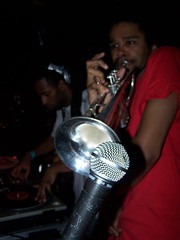
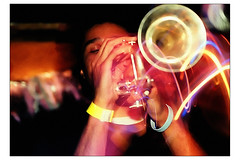
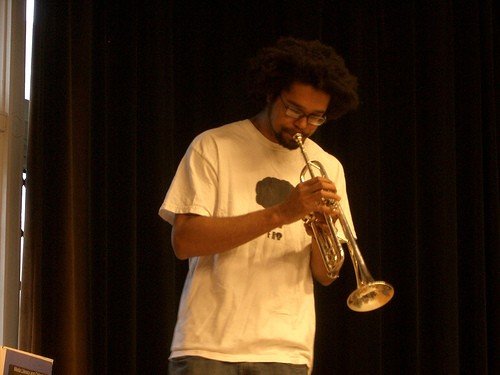
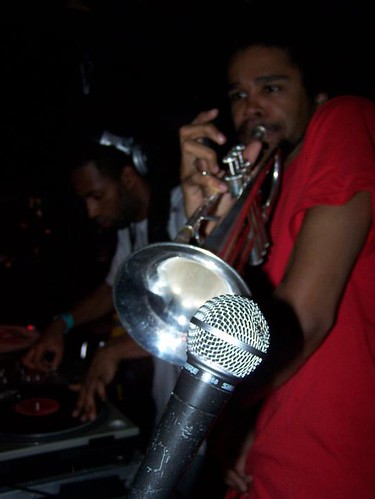
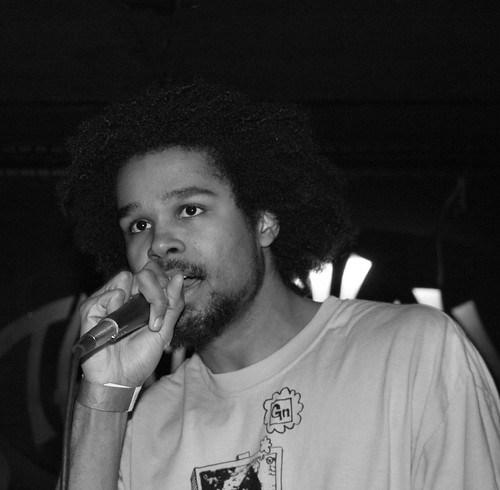
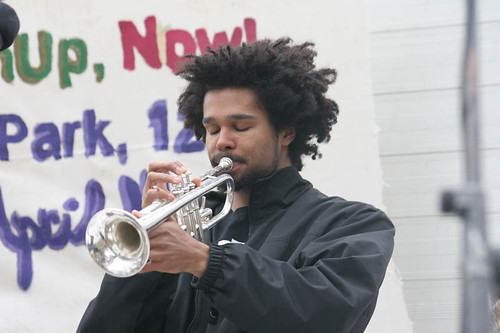
His dad was born in the Democratic Republic of Congo, while his mother was born and raised in Kansas. At Tufts University, he majored in international relations, and after college he has worked in community development and education. One of the causes he supports is the affordability of higher education. Sounds a lot like Barack Obama, but it's actually the pedigree of Pete Shungu - also known on stage as Afro DZ ak - a trumpeter, rapper, and spoken-word poet who writes smooth, jazz-influenced hip-hop and performs in Boston's notorious underground scene. He just released his debut album Elevation on Gnawledge Records, which was founded and is managed by Canyon Cody, BC '06, and Sean Dwyer, BC '04. Despite the difference in occupation, the similarities between his and Obama's personal histories aren't purely coincidental: Obama has constantly been a source of inspiration for Shungu ever since he read Dreams from My Father, in which Obama discusses his life, particularly the reality of his multiracial heritage. This background is one of the subjects Shungu explores in his music.

Shungu was introduced to music at an early age when his mother signed him up for piano lessons. "I was a typical kid who hated practicing, but that kind of sparked my interest in music in general," he says.

In the fifth grade, he picked up trumpet and also started getting into hip-hop, listening to an eclectic assortment of artists, ranging from Public Enemy to A Tribe Called Quest, and from De La Soul to Naughty by Nature and Dr. Dre.

"When you first get into music you don't see the distinction between what's commercial and what's conscious," Shungu says.

He says commercial rap started declining around the time he was developing his own musical consciousness. Around this time, he discovered alternative hip-hop pioneers like Common, Mos Def, and Talib Kweli. From listening to these artists, he developed his own artistic style. He rejected the mainstream's raw, thug mentality and opted for the intelligent, conscientious one of the aforementioned alternative pioneers. For Shungu, music became an approach for tackling important issues.

It wasn't until years later that he discovered his passion for jazz. "My high school had this music director who was really into jazz and completely opened my mind to all different styles of music," he says.

His jazz influences include Miles Davis, John Coltrane, and Freddie Hubbard. He admits that, though it sounds cliche by now, Davis' earlier style in classics like Kind of Blue and Birth of the Cool profoundly influenced his own. He focuses on trumpet playing that is emotional, rather than fast.

"I'm not going to say I can play like Miles or anything, but being about emotion and not being about playing a million notes is something that made me able to play with a lot of different people. In addition to my own album, I play trumpet on probably 15 other albums with hip-hop bands, rock bands, and jazz bands."

Throughout high school, he stuck with his musical commitments by playing in the concert and jazz bands, while also playing soccer. By the time Shungu graduated from high school, he was composing his own parts for trumpet. Once he was in college, he started getting into rhyming and rapping.

"It was kind of a gradual process," he says.

He graduated from Tufts University in 2003, majoring in international relations. Unlike a lot of the musicians he has worked with, he hasn't been in bands all his life; though he wrote music and lyrics, he didn't start performing until after college.

Besides his solo work as Afro DZ ak, Shungu is a former member of the Eclectic Collective and also plays in a six-piece soul band called Soul Movement. He met Dwyer at a show a few years back at the Western Front in Cambridge. The two burgeoning musicians exchanged information, and Dwyer eventually called Shungu. After that, they lived together in an apartment in Somerville, Mass., for a year and half.

"At the time we knew about each other's music. We respected each other and started working on music," he says.

Dwyer, whose stage name is Gnotes, released an album titled Inthrumental in 2006, on which Shungu contributed trumpet parts. After meeting Dwyer, he was introduced to Cody, whom he describes as Gnawledge's "brain child."

"People ask me, 'Are you a part of a label?' I say it's more like a family, a collective of artists supporting each other."

After Dwyer's album was released, the two got to work on Shungu's. It took about six months to put together. Some of the tracks were written as long as four years ago, but most of them were recently put together within the last year, and some of the beats were picked up from friends. All in all, the process was smooth.

"Since I'm a musician as well, a lot of it is organic. I play keys on a few tracks so I'll come up with a keys groove and then make the beats myself."

Dwyer engineered the album, layering Shungu's various parts into catchy, cohesive songs.

Shungu admits that he has no consistent artistic process, but spontaneously writes musical parts and lyrics whenever he is inspired, particularly when he is driving.

"A lot of time I would be listening to instrumentals in the car and come up with lyrics in my head, write them down, and later develop the track," he says.

He currently works for a nonprofit company called Access, assisting high school seniors in the Boston public school system with the financial aid process for college. The job, he says, is a lot like being a guidance counselor, but is solely focused on college preparation. Overall, he loves working in education and thinks it is a good balance for his musical aspirations, and also another source of inspiration.

"The work that I'm doing gives me material to talk about in some of my writing," he says.

His outlook for the future is to keep working on music and in education.

"I don't think I'd feel complete if I gave up either music or working with young people."

August 21, 2008

Interview: Afro DZ ak

This interview took place over email while Canyon Cody was in Spain working on his Fulbright project and Afro DZ ak was in Boston finishing his album Elevation.


Canyon Cody: What did your parents listen to when you were growing up?

Afro DZ ak: My mom played violin when she was younger. She listened primarily to classical music - I remember being a little embarrassed when she dropped me off at school and the other kids could hear classical music blasting on the radio. But now I'm so grateful for being surrounded by classical music when I was young, because it gave me a much greater understanding and appreciation for all styles of music as I got older. My mom also had an old record collection-- The Beatles, Aretha Franklin, etc. Through my dad and his side of the family, I was also introduced to music that reflected my own African roots - both traditional and modern Congolese music. I think the first tapes that I bought included Cooleyhighharmony (Boyz II Men), The Chronic (Dr. Dre) and Greatest Misses (Public Enemy).

Canyon Cody: When did you start playing trumpet?

Afro DZ ak: I first started with piano lessons when I was 8. I think a lot of musical ability came from my mom's brother -- he's a piano and flute teacher. My interest in the trumpet actually came from two sources-- first, I went to a summer camp at a local community college where we got to try out all different types of instruments. When I got to the trumpet, that was the one that really stood out for me. But the main reason I started playing the trumpet was... a girl. Yeah, in 4th grade I had a crush on this girl who played the trumpet. I was real shy back in the day, and I used to think about how if I learned to play the trumpet, I could sit next to her in band class and win her over. So I started playing trumpet in 5th grade. Since she was one of the best players, I had to practice hard if I wanted to move up in the ranks of all the trumpet players and sit next to her. So that was some good motivation. I took private lessons and practiced every day, and by the time 6th grade rolled around I was first chair and she was second! Though the crush wore off, we ended up becoming good friends, and years later I told her about how she helped inspire me to play the trumpet and we were able to laugh about it.

Canyon Cody: Did you learn trumpet on your own or did you have a mentor?

Afro DZ ak: My trumpet teacher's name was Joe Scannella. He was really into dixieland music, so I played a lot of that. More importantly, as a great trumpet player himself, he taught me all kinds of indispensable tips on playing the trumpet that helped me become the player I am today. But it wasn't until high school that I really started to develop a greater understanding and appreciation for music, especially jazz, thanks to my high school music teacher Eric Haltmeier. He got me into Miles, Trane, etc; and the rest is history. I played in a jazz improv group in high school called Microcosm that was led by Mr. Haltmeier, and that was the catalyst for me becoming a specialist at improvisation, versatility, and bringing creativity and feeling into my music.

Canyon Cody: What are some of your favorite hip-hop songs that feature trumpets (either live or sampled)?

Afro DZ ak: It's funny, there's actually more hip-hop tracks with saxophone lines that I really dig than there are with trumpets. Some people can't tell the difference betweent sax and trumpet, but I know instantaneously. Some of my favorite sax samples are Pete Rock & CL Smooth's "T.R.O.Y.", Queen Latifah's "UNITY" and Pharcyde's "Passin' Me By".

In terms of trumpet lines, I love how US3 flipped Freddie Hubbard's trumpet solo from Herbie Hancock's "Cantaloupe Island". I also like that real simple trumpet line on Digable Planets' "Cool Like Dat". Lords of the Underground's "Funky Child" has some dope trumpet samples on it too. I'm good friends with a couple of live hip-hop bands that feature trumpets: Audible Mainframe (from Boston, currently in LA) and Lifted (from Boston, now in NYC). Talib Kweli did this track called "Y'all Stay Up" featuring the Youngblood Brass Band, with live trumpets, tubas, trombones... that track is on point.

Canyon Cody: When did you begin to develop as a lyricist? Were you first a (written) poet or did it come from freestlying with other MCs?

Afro DZ ak: Back in the day when I was a kid, I was always more into creative assignments than essays at school, but I never really wrote my own poetry for fun, it was more just for school. I definitely developed as a musician earlier than I developed as a writer. It wasn't until college that I really started to write my own material, and I actually started writing rhymes before I started on the poetry tip. The first rap I recorded was called "Take the A Train". I think I wrote it while I was home from college sometime before my sophomore year at Tufts. It was a collaboration with my brother Nick (aka Mooks). Originally we went by the name "Afro DZ ak" collectively, but then I took over sole possession of it since he didn't have a 'fro. We recorded it at my brother's friend's house in Jersey, and he had Fruity Loops so I made this real bootleg beat and we dropped the track to it. Back at Tufts, I recorded a couple tracks with Stickemz (aka B Reese) and EZV (aka DJ Health) and freestyled at a parties, but never rocked any real shows until my senior year, which is also when I started with spoken word poetry.

Canyon Cody: From your music, it seems like you believe that music can promote positive change. Have there been songs, or musicians, in your life that have influenced you to be a better person, or work for a better community?

Afro DZ ak: As far as musicians/artists that inspire me, the first person that comes to mind is Omekongo Dibinga. I first met him because he was a TA in a course I took at Tufts called African Politics. We immediately connected, in part because we're both Congolese born in the US. Omekongo was one of the first spoken word poets who really made poetry come alive for me - his poems touched on poignant issues about Congo and Africa in general, about racism, sexism, commercialism, about setting a positive example for young people. Probably more than anyone else, he inspired me to write and perform and develop my own poetry. One thing that stands out to me about Omekongo is that he challenges himself to address issues beyond just those that most obviously affect him. For example, he is one of few Black heterosexual male poets I have seen openly speak out against heterosexism / homophobia in his poetry. He also has traveled the world extensively which I think is crucial for someone to really broaden their own frame of mind, and he works tirelessly with young people (in DC these days) to educate and promote positive messages.

I don't know if there have been songs that have influenced me to become a better person, but there are definitely songs that renew my energy and desire to make change, songs that I just put on repeat sometimes because they sustain me in my quest to make a positive difference. Some songs like that would include Blackstar's "Knowledge of Self (Determination)", J-Live's "Brooklyn Public" (a track about being an inner-city school teacher), Arrested Development's "Mr. Wendal", and Pharoahe Monch ft. Talib Kweli & Common "The Truth". I feel like one of the keys to being an MC is listening, just listening to music all the time, listening to other peoples' constructive criticism, listening to your own heart and staying true to that.


Canyon Cody: Tell me about your work in the Big Brothers program.

Afro DZ ak: I got started with Big Brothers when I was a freshman at Tufts through a community service organization called the Leonard Carmichael Society (LCS). I got matched up with Tevin on St. Patrick's Day in 2000, when he was 8 years old. So we've been matched together for over 8 years now, half of his life. He's changed a lot over time, and he has a lot of negative influences around him, so even though his mom does everything she can to provide for him, I know things aren't easy for Tevin. We have our ups and downs, but over the years we've shared so much together: going to Celtics games, Sox games, museums, the beach, recording music, playing sports, going sledding, just hanging out.

I really consider Tevin a part of my family, I think one of the reasons I first decided to be a Big Brother is because I missed my biological brother Nick when I went off to college. While my relationship with Tevin is completely different from my relationship with Nick (who is now 24), Tevin really is like another brother to me. Tevin and Nick have met each other a few times also and get along real well. Most matches through Big Brothers/Big Sisters last only a year or two, but Tevin and I have developed a bond that goes beyond the requirements of the Big Brothers program and represents a real friendship. He knows that I will always have his back.

Canyon Cody: How did you get connected with The Eclectic Collective and how did you decide to part ways?

Afro DZ ak: I first connected with The Eclectic Collective at concert at Harper's Ferry in Allston, and the promoter (Onslaught, aka Lionel Brown) booked me as the opening act for the show. In addition to The Eclectic Collective, there was another live hip-hop act called Audible Mainframe who performed as well. The whole show was real dope, and it got me excited about live band hip hop/soul in Boston. Especially this one song by EC, "Souls on Ice", which literally made me want to grab my trumpet and jump on stage and start playing while they were performing. At the time, I had recently started playing with a Worcester-based band, Soul Movement, we got booked for another show with the EC. After that show, they asked me if I wanted to join the band, because they were looking to add a horn player to their sound and they were diggin the trumpet that I had played during my solo set and the Soul Movement set.

As far as my leaving the band, that was one of the hardest decisions I've made, but one that in retrospect I'm happy with. In a way, EC was a victim of their own success. Things got to the stage where everyone was quitting their day jobs to tour with the band full time, and I felt like I had too much to give up to do that. I love my job with ACCESS, working with high school students, and both for my own sake and the sake of the students I work with, I wasn't willing to give that up. Also, musically the band was steering more and more away from hip hop & soul and becoming more and more rock, and while the music was still good, it wasn't really me. I wasn't down with putting all my eggs in one basket, especially when I felt like I had so much to offer in my day job. And since I have left the band, I have been able to do so many things, including playing all over Gnotes' and Elemental Zazen's albums, joining the Gnawledge family, and recording my solo album, which I never would have been able to do otherwise.

Canyon Cody: You must really love you day job -- tell me about your what you do.

Afro DZ ak: I am a Financial Aid Advisor for ACCESS (www.accessboston.org). I work one-on-one throughout the school year with High School Seniors in the Boston Public Schools to help them get financial aid for college. Filling out the FAFSA, applying for scholarships, taking out loans, etc; etc; I also do presentations, parent nights, etc; about financial aid. I work in collaboration with teachers, guidance counselors, and administrators in the schools to meet with students during the school day and make sure they get all the financial aid they deserve so that money doesn't prove to be a barrier preventing them from achieving their college dreams.

The strong majority of BPS students receive free/reduced lunch and many are the first in their families to go to college. The vast majority are students of color. The schools I work at are Brighton High School, Greater Egleston Community High School, and Boston Adult Technical Academy. In the process of assisting students with the financial aid process, I also serve as a mentor to countless students, helping them navigate the often overwhelming process of getting through their crucial senior year in high school while putting all the necessary pieces of the puzzle together to go on to college.

May 15, 2008

Canyon Cody Press Clippings

Dj Canyon (Spanish Press)
Interview published in CARMEN, a Spanish magazine based in Granada

November 17, 2005

Hell hath no fury like a rapper scorned
By Canyon Cody
Originally published in The Heights

After Immortal Technique released Revolutionary Warfare, Vol.1 in August 2001, the United States government responded by passing The Patriot Act just two months later. If you thought The Patriot Act and the war in Iraq was about fighting terrorism, then let Immortal Technique drop some gnawledge for you:

"A fake church called the prophet Muhammad a terrorist / Forgetting God is not a religion, but a spiritual bond / And Jesus is the most quoted prophet in the Qu'ran / They bombed innocent people, tryin' to murder Saddam / When you gave him those chemical weapons to go to war with Iran," he raps on "The 4th Branch."

Tech isn't your typical "socially-conscious" rapper with polite rhymes about peace and love. His style is belligerent, his verses are vulgar, and his gnawledge is raw, the sort of stuff you need to chew on a minute. For fans of intelligent, revolutionary, hardcore hip-hop, there hasn't been a better rapper since 2Pac went to Cuba.

Immortal Technique will be performing at the Middle East on Sunday and granted a rare interview with The Heights to talk about his history, his upcoming album, and his controversial political views.

They say hell hath no fury like a woman scorned, but Tech raps with the fury of five centuries of women, men, and children scorned by colonialism and capitalism.

Born in a military hospital in Peru, raised in Harlem, and imprisoned in Pennsylvania before emerging as the most feared battle rapper in New York, Immortal Technique has some serious grievances with the American government.

Kanye recently caused a media frenzy by saying, "Bush doesn't care about black people." Tech's been screaming that for years, with a much more articulate voice and a lot more supporting evidence.

Though he's often compared to rappers like Chuck D, dead prez, and KRS-One, Tech said his real influences are W.E.B. Du Bois, Jose Carlos Mariategui, Malcolm X, Che Guevara, Augusto Sandino, Harriet Tubman, and Marcus Garvey.

Like Ras Kass before him, Immortal Technique doesn't just rap about living in the hood - he understands the larger historic and economic forces that perpetuate poverty and racism. As a result, Tech doesn't peddle petty beefs with other rappers. Eminem raps about having "so much anger aimed in no particular direction," while Immortal Technique points the crosshairs of his scope directly at the heart of the beast: the U.S. government and the corporations that he says control it.

"You might have some house n- fooled, but I understand / Colonialism is sponsored by corporations / That's why Halliburton gets paid to rebuild nations," he raps on "Cause of Death."

But Tech's anger wasn't always focused in the right direction. "In high school I was always doing stupid shit snatchin' nigga's chains, gettin' into fights. I look back and I wonder how I could even live like that, but I brought that attitude with me from the streets to Penn State," he said.

While still in college, he was involved in an altercation sparked by a racist comment that led to a broken jaw for a white student and a year in prison for Immortal Technique.

"When I came home from prison, I was living with my parents. I was on parole and I couldn't get a job. It's a very humbling experience getting out of jail," he said.

Tech started going to battles to earn some money, but ended up also earning a reputation for being a ruthless MC. "I wanted to make sure that people knew that I wasn't just one of these little backpacking fucks who rhymed in a circle," he said in a previous interview. "I never got destroyed or roasted by anyone, period. Anyone who says different is getting their father slapped up and their mother thrown down a flight of fucking stairs just for lying."

"Finally I decided to take all the songs I wrote in prison, with that young angry pissed off voice and release an album. Because even if I sold five a day, that's $50, I could buy groceries with that, you know, I could eat," he said.

The result was Revolutionary Warfare, Vol. 1, which eventually earned him a place in The Source's "Unsigned Hype" column in November 2003. He started getting offers from major labels, but decided to remain independent after reading up on the exploitation of artists in the music business. As a result, he released Vol. 2 independently, which means he owns all of his own masters and pocketed all the profits from the 75,000 copies sold.

Tech's career has been the ideal model for the do-it-yourself underground hip-hop MC. Tech decided against signing to a label because they wanted him to change his style, to downplay his politics, and ignore his black and hispanic heritage.

"That's the difference between the Civil Rights movement and the Black Panther / Hip-hop Generation. In the beginning we wanted to be down with America, not as second class citizens, but really to become full American citizens. We wanted to be down with America so bad that we were willing to fight and die in America's wars. And when we got back, we still weren't allowed to be full American citizens.

"America told us that we were basically here to work and die, kinda like how America treats Mexicans today. We tried that. So now then the hip-hop generation is sayin, 'Fuck waiting for America to accept us. We'll build our own America inside of you.'"

Two years ago, he bragged that, "My grind right now is unsurpassed. I have no booking agent. I have no manager, so it all relies on me. My manager is my voicemail, cell phone, and my e-mail."

He's now vice president of his own label, Viper Records, with plans to release his next album The Middle Passage, in mid-2006. By now I figured he would have hired a publicist who would reply to my interview request, but to my surprise an unknown number from a 212-area code popped up on my cell phone:

"What up nigga? This is Immortal Technique!"

November 10, 2005

Interview with Gift of Gab
By Canyon Cody
Originally published in The Heights


Never take advice from a rapper. If you don't see me back on campus next semester, blame Gift of Gab from Blackalicious.

While interviewing him over the phone, Gab's advice to me was, "Take the cash from your student loans and start a record company. That's what we did." I explained to him that Boston College doesn't have much of a hip-hop scene and he laughed.

"Neither did UC Davis," he said, "but that's where we all met. Me, DJ Shadow, Lyrics Born, Lateef, Xcel - we all met at the college radio station."

With misappropriated tuition money, the crew started SoleSides Records in 1992, later to become Quannum Projects. The independent label released Blackalicious' first two EPs, Melodica and A2G, and its full-length debut Nia. The duo finally signed to a major label in 2000 and unleashed Blazing Arrow, one of the most sublime hip-hop albums ever released.


A-Side
Blackalicious - "Powers"

The new Blackalicious album, The Craft, sounds surprisingly little like its predecessor. Instead of chopping up samples, Blackalicious producer Chief Xcel put together an all-star band featuring Spearhead bassist Carl Young and Beastie Boys percussionist Alfredo Ortiz to create the lush instrumental sound heard on tracks like the lead single "Powers," "Supreme People," and "Lotus Flower," featuring George Clinton.

"What I love about this album is that you can't tell what's a sample and what's a live performance," said Gab. "Xcel originally made the beats on the MPC, but then stripped them down.

"Then we went into the studio with the band and they just jammed on top of his beats for like eight hours a day, three days in a row. It was like a Miles Davis session. Then we took the best parts of the jam session and Xcel's original beats and put them together."


B-Side

Blackalicious - "Rhythm Sticks"

While Xcel drives the beat, Gab rides the groove with his signature lyrical gymnastics. Keep your finger near the rewind button because Gab's got the sort of ridiculous flow that demands a double take. Gab is probably too hooked on phonetics, rehashing his infamous exercise in extended alliteration reminiscent of "Alphabet Aerobics."

Blackalicious - "The Fall & Rise Elliot Brown"

"I've been rapping since I was 12, just battling kids in the neighborhood, so for this album I wanted to do something more. I wanted to tell stories that created visuals for the listener," he said. The album is a cinematic experience that reinforces Gab's reputation as a socially conscious emcee who manages to avoid the temptation of hippie-dippy proselytizing.

"I don't consider myself a political person. I just use common sense. I'm an observer. If I see something happening over and over again in my community, then I make the connection and I comment on it."

April 21, 2005

k-os interview
By Canyon Cody
Published in The Heights

With a traditional drummer, a hand percussionist, and a DJ tapping beats on his MPC, rhythm filled the Paradise on Tuesday, with Canadian rapper k-os leading the crowd through a powerful, but disappointingly brief set while opening for Handsome Boy Modeling School (HBMS).

It was no easy task recreating the diverse instrumentation on k-os' two phenomenal albums, 2002's Exit and 2004's Joyful Rebellion. Instead of bringing a brass section on the tour bus, k-os delegated the responsibility to his guitarist, who proved his Spanish flamenco skills with blurred hands.

K-os' music has a natural energy to it that makes it sound more alive than the majority of over-produced commercial rap. During our interview, k-os talked about his musical roots in Trinidad, where he lived before moving to Canada when he was 12.

"Watching my uncle in Trindad making steel drums at home from scraps of metal that he found, that really gave me a grass roots understanding about music and how you should make it," he said.

K-os enjoys considerably better success in Canada, where any of his five music videos are regularly played on Canadian television. His first single, "Crabbuckit," won him Single of the Year at the Canadian Juno awards.

When he performed his hit single, the electric standup bass player strummed the song's infectious baseline, which it borrows from The Cure's "Love Cats." Instead of referencing The Cure, the more obvious earlier owner, k-os led the crowd into its original owner, "Hit The Road Jack."

For k-os, touring in America is always a strange experience, one that he admits he doesn't especially enjoy. He has toured Europe with The Roots, but looks forward more than anything to performing back home in Trinidad. K-os said he's not surprised that he doesn't get as much exposure in America.

"America blasts its music all over the world, and it makes it seem like the only way to be black is to be American black.

"Especially with hip-hop, Americans totally ignore black people in Canada, or in the Caribbean, or in Africa. That's why I was so into Bob Marley, because he was this black guy who was totally not American and America couldn't ignore him," he said.

HBMS headlined the concert, but disappointed with an inevitably unsatisfying perormance. The recent HBMS album, White People, is a beautiful collaboration between two producers, Dan the Automator from Gorillaz and Prince Paul from De La Soul, featuring guest appearances from Del tha Funkee Homosapien, Barrington Levy, Cat Power, and Jack Johnson.

Of course, none of these people were on tour with HBMS, just waiting backstage all night to perform their one contribution. Instead, HBMS decided to simply play their beats with cartoons of the guests projected on a screen behind them.


HBMS tried to compensate for the absent performers by incorporating skit comedy in its show. After k-os, the crowd seemed amused, but mostly disappointed.

Photo by Anna Schindelar

March 3, 2005


Interview with Citizen Cope
By Canyon Cody
Published in The Heights

Rarely will I do this, but I'm going to spare the reader a long-winded introduction and just come out and say it: You need to stop reading this and go buy Citizen Cope's new album, The Clarence Greenwood Recordings.

If you don't like it and later regret your purchase, I will personally refund your money. That's how good this album is.

There's nothing especially unique about what Citizen Cope does - he's a singer-songwriter in the tradition of Woody Guthrie, John Steinbeck, and Bob Dylan, but Cope incorporates subtle hip-hop rhythms to accompany his gritty, woeful wail and acoustic guitar. Beck is the closest thing around today to Citizen Cope's hybrid of folk, funk, and hip-hop.

But while Beck busies himself with experimental meanderings, Cope gives listeners what they want, proving that it's better to be good than unique. There's no need to reinvent the wheel, as long as you roll with style.

Nowadays, singer-songwriters tend to be pretty boys with pretty songs, but Citizen Cope sings about his reality, which hasn't always been pretty.

"I sing about the people around me, the people I've met in D.C. and all over the place, but they're not always normal, model citizens," said Citizen Cope during our recent interview.

Listening to Citizen Cope is like reading a Jack Kerouac story filled with lovers and lunatics. On "Pablo Picasso," Cope sings from the perspective of a deranged man in love with a woman painted on a wall mural. Even when he sings about someone estranged from reality, it is obvious that Cope sings with sympathy.

"I try to put myself into the reality of the character, no matter how crazy he is," he said.

Citizen Cope, aka Clarence Greenwood, released his self-titled debut in 2002, but soon after left his record label, Dreamworks, because they weren't sufficiently promoting his album. He bought himself out of his contract using the advance from his next album and then signed to Arista, recording The Clarence Greenwood Project in the interim time.

The album's lead single, "Bullet and a Target" features Citizen Cope at his best. Cope layers piano and strings over the best beat you'll ever hear on a singer-songwriter's album.

The rhythm and percussion stands out throughout the album, integrating hip-hop breakbeats and live drums.

"When I was growing up, I tried to learn the guitar and the trumpet, but I couldn't play at first, so I started making beats, messing with drum machines and samplers," said Cope.

Before he was Citizen Cope, Greenwood was the DJ for a funky, laid back Washington, D.C. hip-hop crew called Basehead.

"Hip-hop taught me a lot about song structure, about the idea of measures and choruses," said Cope.

Cope's previous dabbling with hip-hop shaped his cadence, rhyme scheme, and narrative structure, but in contrast to Everlast or Wyclef Jean, Cope's hip-hop influence is subtle and well integrated.

In Citizen Cope's music you can hear bits of Bob Marley, bits of Ben Harper, and bits of Al Green, but Citizen Cope is no carbon-copy imitator.

His music is deeply personal and there's an audible honesty in his words. Citizen Cope's songs reflect the natural genesis of his musical talent.

"I couldn't afford all these expensive drum machines and samplers, so I just picked up the guitar and started plucking at it one string at a time, getting to know each string with my heart, instead of trying to understand it with my head," said Cope.

The album features a guest appearance from Carlos Santana on "Son's Gonna Rise," a hectic tale about racing to the hospital with his pregnant wife going into labor in the backseat.

Me'shell Ndegeocello plays bass on "Sideways," a beautiful song full of pathos and regret about lost love, where Cope laments, "These feelings won't go away."

Soon everybody will know about Citizen Cope, but before then you can take advantage of his relative obscurity by seeing him perform at the intimate Paradise Lounge on Wednesday.

February 24, 2005

Police shut down BU porn magazine release party
By Canyon Cody
Published in The Heights

"I expected more nudity," complained one Boston University student at the release party for BU's new porn magazine Boink.

Compared to the full-frontal male and female nudity inside the new magazine, the release party at the Roxy on Thursday was quite tame. Large ice luges in the shape of male and female genitalia were the only open demonstration of private parts at the club, other than the pictures featured in the 96 page inaugural issue.

The party at the Roxy was billed as an adult-themed night and the invitations specifically stated that all attendees must be over 18 years of age. Unfortunately, that's not adult enough to legally drink in the state of Massachusetts, and as a result of underage drinking, the whole club was shut down at 12:30 a.m. by police and officials from Alcohol Beverage Control.

Until that point, everyone seemed to be enjoying themselves on the dance floor and it took the police quite some time to get everyone to actually leave. Most people stuck around to get a free copy of Boink before they left.

Boink is similar to the new sex-themed Harvard magazine H-Bomb, except Boink is unabashed porn, featuring BU students as models, writers, and photographers. The undergraduate models featured nude in the magazine, both male and female, were all in attendance at the release party.

During out interview, Alecia Oleyourryk, a BU senior from upstate New York and the creator of Boink, said that the magazine is an accurate reflection of the interests of normal college students and reminded everyone that the magazine also includes articles concerning college sex life.

Subscriptions to the magazine are available from its Web site (www.get-boinked.com) and single issues will be sold at Newbury Comics. According to Boink's Web site, "the title was selected because it's dynamic and fun, like the sex act to which it refers."

Boink will be sponsoring sex-themed discussions at BU beginning on March 3, when the magazine will host a talk at BU with Jen Sincero, author of The Straight Girl's Guide to Sleeping with Chicks.

October 25, 2004


Seniors love their Two-Car Garage
By Canyon Cody
Published in The Heights

A few guys from different parts of the country meet each other during their freshman year at college. At first, some play instruments, some don't. They become friends and eventually form a band. They move in together off campus and turn their basement into practice space. They perform for their friends at local bars. This is how real bands get started.

Local band Two-Car Garage is part of a college tradition as old as cold pizza for breakfast, but unfortunately it is a tradition largely unpracticed here at Boston College. After forming at the end of their sophomore year, the members of Two-Car Garage moved off campus, where they evolved from a bunch of friends who jammed together into a band.

Drummer and song-writer T.J. Gordon, BC '05, says it was the band's time living off campus together that offered all of them the chance to improve as individual musicians and come together as a group. "We had a constant practice schedule, which was great for me, because I had become the band's drummer by default since we didn't have anyone else," says Gordon.

Last year, the band started playing at different BC events, including a benefit concert for the Emerging Leader Program and the Another Choice on Campus talent show, where it won third place. It was last year's undergraduate government-sponsored Battle of the Bands where the band first caught BC music fans' attention, winning first prize.

The band features dueling guitarists and vocalists Anthony Camilleri, BC '05, and Ethan Schuler, BC '05, who both reference local bands Dispatch and Guster as musical influences. Schuler sings in the University Chorale but had never played guitar before coming to BC. Camilleri, on the other hand, has played since he was 14 years old and spent an entire summer assembling pipe hangers in a factory to earn enough money to buy his first guitar. Bassist Justin Virojanapa, BC'05, might have also ended up as a guitarist if it wasn't for his older brother, who already played guitar and needed a bassist for his high school band.

Two-Car Garage's most ear-catching member is violinist Dave Samikkannu, BC '05. His bandmates describe him as the most musically talented in the group, having played classical violin since he was 4 years old. "There are a lot of songs that don't have a part for the violin, but he's so amazing that he can just listen to it a couple of times and fiddle around, no pun intended, until he finds a good place for the violin in the song," explained Gordon. Sometimes, the band even transcribes the lead guitar part into something that Samikkannu can play instead.

Two-Car Garage branched out from campus this year and began playing local college bars, such as Kinvara, where the band played Oct. 5. "It's hard to get started as a band while you're in college because you basically need to bring the crowd with you, but most of your friends can't come out to see you at a bar until your senior year," said Gordon.

The Kinvara show gave the band a chance to play a few fun covers along with the band's 13 originals. "With the violin, everybody expects some Dave Mathews Band, and we give them what they want. We'll do 'Ants Marching' because of the great violin solo, but also 'The Devil Went Down to Georgia,'" said Gordon. "Just for fun though, we'll also throw the Spice Girls' 'Wannabe' in there, too."

Now that Two-Car Garage has managed to bring crowds to its concerts, the group's members have started looking into the future, especially considering that they are all seniors. At least of few of the band members will remain in Boston, but for now they are focusing on performing and recording during the rest of this year.

Two-Car Garage will perform at Great Scott's on Nov. 8 and then return to Kinvara on the last day of classes, Dec. 10.

October 14, 2004

Ozomatli Explodes with Energy Onstage
By Canyon Cody
Published in The Heights

One could waste plenty of hyphens trying to describe Ozomatli's sound: Hispanic funk-rock-rap with salsa-merengue roots and punk-rock energy. Describing Ozomatli's live performance needs far fewer words: remarkable.

The Los Angeles-based 10-man collective brought a contagious energy to The Paradise Rock Club on Tuesday night and maintained complete control of the ecstatic crowd throughout the two-and-a-half hour show, which featured an uninterrupted flow of songs from the group's self-titled debut and its newest release, Street Signs.

The band's rowdy cacophony of horns and percussion inspired excited dancing from everyone in the crowd. The only people who seemed to be enjoying themselves more than the screaming crowd were the ebullient performers onstage who jumped and screamed with a seemingly ceaseless supply of energy.

With a dozen multi-ethnic musicians onstage, Ozomatli is truly an international orchestra in which timbales, turntables, and trumpets come together for a free-wheeling party of rhythm and horns. The performance featured solos from nearly every member, including the dirtiest clarinet solo Boston has heard since Benny Goodman.

Ozomatli also features two emcees, Justin Poree and Jabu Smith-Freeman, who throw poltically-conscious verses on top of the polyrhythmic percussion of drummers Jiro Yamaguchi and Mario Calire.

The rest of the band, when not performing, chips in with additional percussion by banging away at anything they can hit with a communal set of drum sticks circulating on stage.

In an interview following the concert, Yamaguchi told me, "Playing in Boston is fun because the crowd is full of college students who are trying to have a good time. As for us, we always have a good time."

The highlight of the evening came with a guest appearance from trumpet genius Tony Lujan, who dazzled the crowd as he was accompanied by mariachi guitar played by Raul Pachecho [ed. note: a fellow Thacher alum] and scratching from turntablist Rene "Spinobi" Dominguez.

Without any single leader, Ozomatli is truly an ensemble of superb musical talent who know how to rock a crowd. It would be nearly impossible to avoid catching the infectious energy that literally comes down from the stage as the members of Ozomatli descend into the crowd for a conga line that ends each of their shows.

After the band's conga line at the South by Southwest Music Festival last year ended with two members in jail for a noise ordinance violation, Ozomatli kept this rowdy party indoors.

The only thing better than Tuesday night's show would be seeing former members Chali 2na and DJ Cut Chemist (now of Jurassic 5) performing with their old crew. Nevertheless, any fan of live music should never miss an opportunity to see Ozomatli perform.

May 25, 2004


Dwyer to release post-grad hip-hop album
By Canyon Cody
Published in The Heights

Beggars can't be choosers, which is why most young artists are forced to accept the undesirable terms and conditions of a music contract with a major label when offered the chance.

Sean Dwyer, on the other hand, demanded more than any record company would offer: "I want complete creative freedom and I want to own all of my own music."

In an industry where Michael Jackson, and not Paul McCartney, owns the rights to the Beatles' entire catalog, Dwyer quickly realized that he was going to have to record, release, and distribute the album himself in order to avoid sacrificing his artistic rights.

Trying to do all of this while still fulfilling his school responsibilities as a full-time student at Boston College Lynch School of Education proved nearly an impossible task and, as a result, his album remains unfinished as of gradation.

"I really wanted to have it all done by graduation so my friends could hear it, but trying to do it all by myself while I was still in school was just too much," he said.

Sadly, this means that only a handful of people have heard even the unmastered demo copy of his solo debut, tentatively titled Broken Spoke. The hip-hop album boasts production from Alec Tervenski, BC '04, who is known as Adept and also produced beats for fellow Boston College emcee Noah Dixon, BC '06. Noah's full length debut album will be released in September.

As a senior, Dwyer won't be back at college in September, so this summer he plans on finishing the album and finally releasing it. Most of the album is already complete and was recorded in BC's recording studio in Campion.

Dwyer said, "I had all of my classes in Campion and never even looked in that room. I certainly didn't expect there to be a recording studio behind those doors."

Dwyer's rhymes are careful poetic constructs delivered with a self-assured confidence that avoids the typical rapper's arrogance. Unlike many rappers, Dwyer's lyrical content doesn't hide behind the beat. Even if you took the beat away from his verses, they easily become poetry that can stand on their own merit.

As a result, you are just as likely to see Dwyer reading his work at an open-mic poetry show as you would be to see him freestyling at an emcee battle.

Or you might even see him without his rhymes all together, singing and playing acoustic guitar at a local bar with alum Ryan Read, BC '02. Before playing music together, they played football at BC before Read graduated and Dwyer quit the team.

During his junior year, Dwyer went abroad to Florence, Italy. He said, "In Italy, I was really removed from hip-hop culture, so I really focused on my writing and guitar playing. When I came back I was excited to get back into rapping again, because it definitely made me a better writer and better musician in general."

It was also in Italy where Dwyer first started playing music professionally: "I had been doing the open-mic thing for years, but in Italy I had a job playing guitar in local club. The idea that someone would pay me to do what I love, to play music, was crazy to me."

When Dwyer returned to BC, he began playing again with Read, performing at O'Briens, Becket's, and other bars around Boston. Dwyer also has an acoustic guitar album recorded with Read and there are plans for another in the making.

Now that he will be graduating, Dwyer says he can finally focus on his music. "Even though looking back on it, I know I had lots of time and I probably could have done it, trying to do all the business parts of it while still getting homework done and trying to write new music was just too much," he said. "Hopefully this summer everything will be done."

Careful with his words and yet strong in his delivery, Dwyer has a lot to offer as an emcee, but what distinguishes him from the rest are his impressive musical skills and ability to write a cohesive narrative. Especially today, hip-hop needs more musicians and poets like Dwyer.

March 23, 2004

Murs Interview
By Canyon Cody
Published in The Heights

Canyon Cody: On your new album you say, "I wanna blow up/ but I don't wanna go pop." Why do you think some artists refuse to sell out, and why do others seem to have no problem with it?

Murs: It's just the respect you have for yourself and for hip-hop. I'm too proud of my music to do some stupid sh-.

CC: Do you think those other people, someone like Da Band or Loon, are proud of their music or do they just not care?

M: Loon is different situation. He's from my 'hood, he grew up near where I'm from. He's got some problems, decision-making stuff, and that's always been the case. I dunno, his brain wiring is all f-ed up.

CC: How has your life changed since you signed to Def Jux? Because even though it's an "underground" label, Def Jux still has the resources to really promote your album.

M: It's been good. Good and bad. I mean, I still haven't seen any money from Def Jux. In fact, I'll probably end up owing them money after this whole thing, but that's just the way the music industry is. I still haven't enjoyed the sort of success that I feel like I deserve, especially for how hard I work. I'm not blaming anyone; it's just not my time yet.

CC: On your last album you said, "If I don't go gold, then my people say I flopped/ But if I go triple platinum, I'm not hip-hop." What would be a success, in terms of sales, with your new album?

M: I'd be happy to move 100,000 units. I'd love to sell 13 million records of course; it's not like I'm trying to keep my album sales down because I'm in the underground or whatever. But I'm not 50 Cent, and that doesn't bother me. I'm not mad that I'm not friends with Ludacris. I like my group of friends. I'm proud to be friends with talented people like [Def Jux founder] El-P.

CC: How do you feel about people downloading your album from the Internet?

M: I totally understand why kids download. As long as they get my stuff and they like it, I can't really get too mad. I'm still a huge hip-hop fan like them. I go out and buy like three or four albums every Tuesday, but that's because now I'm in a financial position where I can do that.

CC: Has making hip-hop a profession affected your love for the music?

M: Yeah. I mean, that hasn't really happened to me yet, but I can see how the business could do that to you.

CC: Is that one of the reasons why you've been considering retiring?

M: Oh for sure. Really though, it's just that I don't really get along with others.

CC: Anything else on your mind?

M: Yeah, I wanna give a shoutout to John Cena and Trademark. And I'd like to say that Gordon from Sesame Street is an adulterer and a punkass b-. And you better come to the show.

March 16, 2004


De La Soul is not dead
By Canyon Cody
Published in The Heights

Hip-hop pioneer De La Soul brought its left-of-center flow to the Middle East on Feb. 28 to support Music for America, a partisan, political nonprofit organization working toward getting one million new young voters to participate in the 2004 elections by promoting concerts around the country.

For years, De La Soul has being trying to shake its "hippy-hop" image earned after its classic debut Three Feet High and Rising, but De La Soul members Pos, Trugoy, and Maceo have resisted the temptation to exaggerate their gangster image to compensate for their undeserved flower child reputation. Onstage, De La Soul came off as it does on its albums: friendly, smart, fun, and easy-going.

Opening for De La was 4th Pyramid, who is promoting his single on the new compilation from underground hip-hop super-label Def Jux, where he recently signed. 4th Pyramid, an emcee from Toronto, caught the attention of the underground with an instrumental album he produced when he was just 16 years old.

In an interview with The Heights, 4th Pyramid said, "This whole thing is huge, but look, I'm still out here all on my own. I mean, I ain't got no tour manager, no DJ with me on the road. Right now, I'm a one-man wrecking crew, a one-man army. But just wait for [Def Jux] to roll through when we're on tour."

Also opening was Zonk, a trip-hop band from the Bay Area in California. They won a download contest with Music for America, which awarded Zonk with the chance to open for De La Soul. The band was filled with vibrant energy and played an excited set of diverse music, with lead singer Nic McFiendish bouncing across the stage with the microphone stand straddled between her legs the entire time.

The highlight of Zonk's performance was when two emcees, Bolo of Pawray and Mic Kaos, came up to give the band some hip-hop flavor. Like De La Soul in the '80s, Zonk's most enjoyable quality was that it seemed like they were having a good time along with the crowd on stage.

Once De La Soul arrived, the crowd exploded, but not in the raucous way one expects from a hip-hop crowd. Of course, De La Soul doesn't attract the typical hip-hop crowd and, as expected, the Middle East seemed to be filled with people drinking who probably used legal id. to get a wristband.

Despite recently releasing two great albums in the Art Official Intelligence trilogy, most of De La Soul's fans were initially attracted to its groundbreaking earlier work. As a result, the crowd reacted the most to classics such as "Me, Myself and I" and "Roller Skating Jam Named 'Saturdays.'" During our interview, De La Soul frontman Posdnous said that a new album is finally set to come out later this year. "We had a lot of trouble with our last record company, who weren't going to release part three, but now we're pretty much ready to put it out there. We also have another album coming out after that, but it doesn't even have a name yet."

Unfortunately, De La Soul stuck to its popular old stuff and didn't bless the crowd with any tastes of the new album.

During an intermission, a video played with a brief segment put together by the concert organizers. They tried to convince the crowd to vote by reminding everyone how close the result of the presidential contest was in 2000. After the show, they handed out packets filled with 10 mail-in voter registration forms and information about such issues that are important to young voters, such as reproductive rights and education funding.

After the show, De La Soul stuck around to talk to fans, which mostly consisted of women who were invited on stage by Pos and Trugoy (who now just goes by Dave) for their closing ode to meaty girls, "Baby Phat." The show was entertaining and proved that De La Soul still has quite a bit of soul left in it and that it's not yet time to retire De La's number into the hip-hop Hall of Fame.

February 10, 2004

Beatles Sing Back-up for Jay-Z
By Canyon Cody
Published in The Heights

When John Lennon said, "Music is everybody's possession. It's only publishers who think that people own it," clearly he failed to anticipate underground hip-hop producer DJ Danger Mouse.

Danger Mouse (DM) has taken the anarchy of musical intellectual property to a new level by remixing Jay-Z's Black Album, using nothing but samples from the Beatles' White Album, creating an impressive and entertaining new remix, The Grey Album.

When Jay-Z released the a capella version of his entire Black Album on vinyl, he seemed to be offering his tacit approval for DJs remixing his vocals onto their own beats. In just a few months, no less than six major producers have offered their own versions of Jay-Z's final album.

The remix fad began with 9th Wonder, when he remixed Nas' God's Son, layering Nas' vocals on top of his own signature fluid, old school beats. The remix project earned the unknown producer so much buzz that when Jay-Z was gathering his all-star list of producers for The Black Album, he included 9th Wonder.

At first, Danger Mouse wasn't even going to do his own remix, since he knew that so many other DJ's would be doing the same. He was busy working on other projects, including the follow-up to his stellar debut album with emcee Jemini, Ghetto Pop Life.

Then, the idea of taking samples exclusively from the Beatles' White Album dawned on him. "I did it real quick," Danger Mouse told The Heights in an interview, "because I was afraid someone else was going to have the same idea." After just two weeks and over 200 hours of studio time, Danger Mouse released his remix.

The Grey Album is awe-inspiring collage of Ringo's snare, Paul's bass, Lennon's voice, and Harrison's weeping guitar that demonstrates the delicate art of sample-based production. Some songs are immediately recognizable as looped samples, while DM rearranges some songs to an almost indecipherable effect.

"It was basically just an experiment for me, like an art project," DM said. "I'm actually surprised people like it because I really just did it for me. It was a test, like 'For this song I have two loops and that's it, so let's see what I can do with that.'"

On "What More Can I Say," when Jay-Z's first verse drops on top of a slowed down guitar riff from "While My Guitar Gently Weeps," the collaboration at first catches the listener off guard. Fortunately, the quality of Danger Mouse's production eclipses the gimmick that initially piques listener's interest.

Many will listen to the album simply for the concept's novelty value, but this is no generic mash-up. On "Dirt Off Your Shoulder," DM takes "Julia," speeds it up, slices it in half and throws some meat on the beat until it's an entirely new song.

As Nick Hornby writes in Songbook, to accuse an artist like Danger Mouse of plagiarism is ridiculous: "You may as well make the same case against a writer whose book contain words that other writers have used before."

Unfortunately, copyright law does not agree. Sampling has been a rich man's game ever since Biz Markie was sued for sampling in 1991. The judge ruled that the Biz had violated "not only the Seventh Commandment, but also the copyright laws of this country."

Danger Mouse knew there was an insurmountable sample clearance issue that prevented him from releasing the album commercially and instead made the album available to friends and fans on underground hip-hop sites on the Internet. Recently, the album has even disappeared from these non-traditional venues.

Danger Mouse suggests, "Go find it on the Internet and make copies for your friends. I knew I was never going to make money off this, that wasn't why I did it."

On "Encore," DM's production reaches its most impressive point, with a looped breakbeat from "Glass Onion." Halfway through the song, DM switches the beat to a short drum-based sample from 1:08 into "Savoy Truffle."

On some songs, such as "Moment of Clarity," Danger Mouse falters and fails to create an engaging beat from the scraps of "Happiness Is A Warm Gun." Similarly, The Beatles' "Cry Baby Cry" doesn't seems to be able to keep up with Jay-Z's double-time rhyme on "My 1st Song."

The Grey Album shows what Danger Mouse and sample-based production in general is capable of, if not for the financial limitation involved in clearing samples. Most likely this sort of art will continue to flourish in the underground, below the radar of record label lawyers but just perfect for true hip-hop fans.